
Buy, Rent, or Optimize: The Compute Decisions Now Defining Indian Game Studios
For years, compute behaved like electricity.
We assumed it was there. We priced it as a variable cost. We bought it at the end of the build cycle, never before.
That assumption has quietly broken.
In 2026, compute is no longer a utility a studio buys. It is a constraint a studio is allocated. And that single shift is reshaping how games get made, what they cost, and who gets to build them at all.
Most founders are reading this as a procurement problem. Expensive GPUs. Sold-out memory.
It is actually a strategy problem.

The Problem: The Shortage Is Not Where You Think
The instinct is to blame chip fabrication, the printing of silicon itself.
That is the wrong layer.
The real bottleneck in 2026 is not making chips. It is the advanced packaging that bonds those chips to high-bandwidth memory. TSMC's CoWoS packaging is the funnel the entire high-end AI industry must pass through, and demand for it has roughly tripled in two years, from around 370,000 wafers in 2024 toward nearly a million by the end of 2026.
Capacity has not tripled. So a handful of buyers have locked it up.
NVIDIA alone has secured an estimated 60% of that packaging output. The top three buyers control more than 85%. Even Google reportedly cut its in-house chip target by a quarter because it could not get enough packaging slots.
Sit with that for a second.
When the largest technology companies on earth are rationed, the position of a game studio in Pune or Bengaluru is not weak. It is invisible. You are not competing with other studios for compute. You are competing with the entire AI economy, and you are at the back of the line.
How the Shortage Reaches the Studio Floor
The squeeze travels through two doors, and both open directly onto game development.
The first is the consumer GPU.
The same memory production that feeds AI data centers feeds the graphics cards your developers build on. Because data-center memory is far more profitable, manufacturers have diverted capacity toward it. NVIDIA reportedly cut consumer card production by 30 to 40% to protect higher-margin enterprise supply.
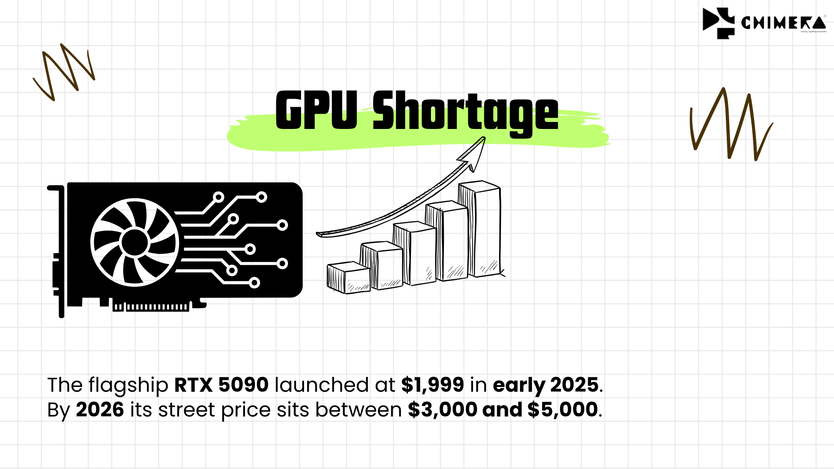
The result is visible on any price tracker. The flagship RTX 5090 launched at $1,999 in early 2025. By 2026 its street price sits between $3,000 and $5,000.
For a studio, that card is not a gaming toy. It is a workstation, a local AI box, and a render node. Its price is now set by a market that has nothing to do with games.
The second door is the cloud.
The old belief that cloud costs always fall is gone. The same class of GPU can cost three to four times more on a major hyperscaler than on a specialized provider, before data egress fees quietly trap your workloads where they land. An H100 runs around $12 an hour on one hyperscaler and as low as $1 an hour on a lean neocloud.
Same chip. Twelve times the price. Most studios never notice, because they treat cloud as one line item instead of a market to be worked.
The Buy-vs-Rent Decision Is a Capital Call, Not a Purchase
The core call is buy versus rent. Utilization is the largest input, but it is not the only one, workload variability, capital runway, project timelines, resale value on owned hardware, egress lock-in on cloud, and how quickly your compute needs will change all feed the same decision.
Treating it as a single-variable choice is exactly how studios pick wrong.
For heavy, continuous work, compiling shaders, baking lighting, fine-tuning local models eight hours a day, owning hardware is dramatically cheaper. A local build runs roughly $7,000 over two years. The equivalent reserved cloud capacity can exceed $120,000 over the same period.
For sporadic work, the math inverts, and renting on spot markets wins.
Most studios never run this calculation honestly. They pick one mode by habit and absorb the waste.
That waste has a name worth borrowing: infrastructure debt.
Across enterprise AI and data-center deployments, a large share of GPU capacity runs at strikingly low utilization, industry analyses put average enterprise GPU usage near 5%.
Idle compute quietly burns money against gross margin. On thin Indian ARPU, that is not a rounding error. It is runway.
Compute discipline now sits next to retention and monetization as a thing that decides whether a studio survives itself.
The Engine Choice Now Carries a Cost Structure
The same logic reaches into your engine choice.
The split between the heavy, cinematic engine and the lean, scalable one used to be read mainly through fidelity. Increasingly, it also carries an economic dimension.
Unreal Engine 5 delivers high-end fidelity through systems like Nanite and Lumen, which are demanding on hardware and best suited to higher-spec machines. Unity 6 has optimized in the other direction, targeting dense scenes on mid-tier phones and devices. Both are deliberate trade-offs, not a better-or-worse call.
In a constrained world, that trade-off shows up on the balance sheet. An engine that assumes a high-end card on every developer's desk, and a powerful machine in every player's hands, carries cost at both ends of the funnel. An engine tuned to run lowers build cost and widens addressable market at the same time. Neither is wrong; the point is that the choice is now partly a capital decision, not only a creative one.
Optimization is no longer only a finishing step. It is increasingly a capital strategy.
What This Means for India
India enters this moment without leading-edge chip fabrication.
Every high-end GPU is imported. Domestic manufacturing is real and accelerating, Tata's fab in Dholera, Micron's packaging plant in Gujarat, but it targets mature chips and memory assembly, not the advanced silicon that powers frontier AI. That capability is years away. Pretending otherwise helps no one.
But the more useful read is structural.
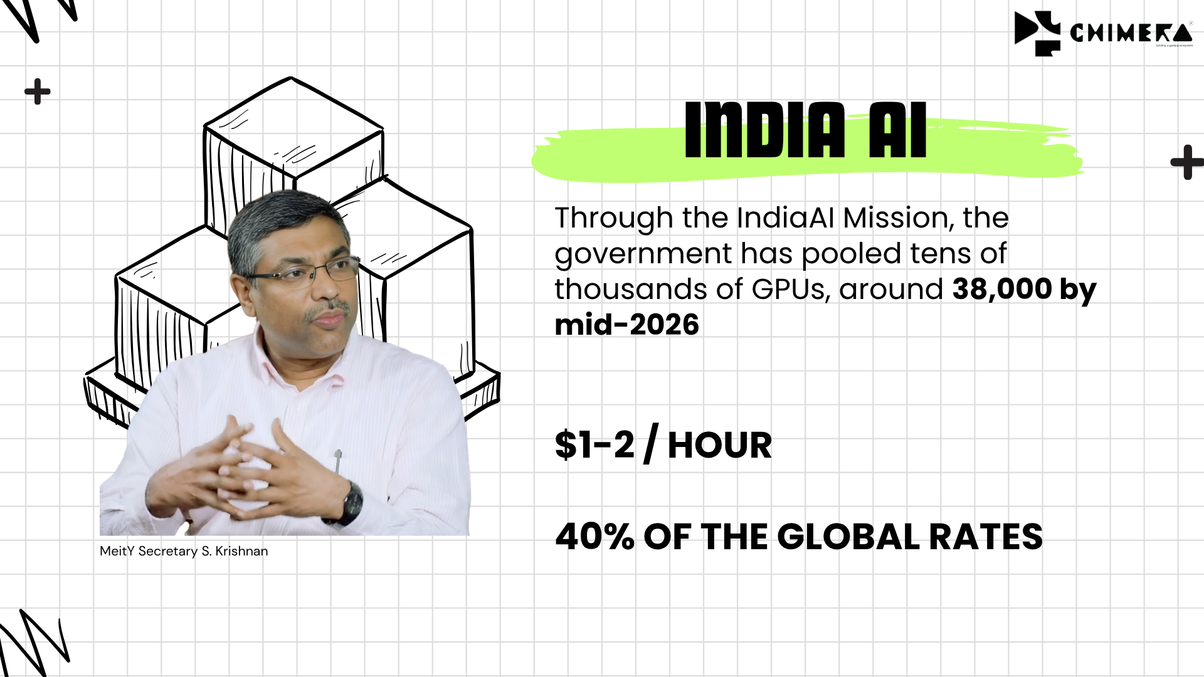
India has chosen to subsidize the gap rather than wait to close it. Through the IndiaAI Mission, the government has pooled tens of thousands of GPUs, around 38,000 by mid-2026, and offers them to startups and researchers at roughly $1 to $2 an hour, about 40% below global rates.
Much of that hardware suits inference and fine-tuning rather than massive training runs.
That is not a weakness. That is the point.
India is not being handed the ability to brute-force scale. It is being handed the conditions that force efficiency. And the world is moving toward inference, projected to be two-thirds of all AI compute spending, which rewards exactly that discipline.
A studio that learns to ship under rationed compute in Bengaluru is not building for a poor market. It is rehearsing the operating model the entire industry is converging on.
There is one real risk, though.
Compute access is concentrated in metro hubs, while creative talent increasingly emerges from Tier-II and Tier-III cities. If GPU access does not follow that talent, the bottleneck simply moves, from global supply chains to domestic geography. Infrastructure has to chase the builders, not the other way around.
Chimera's Take
We read the compute shortage as a sorting mechanism, not a passing headwind.
It is quietly separating two kinds of companies. Those that treat compute as a cost to be procured. And those that treat it as a constraint to be engineered around.
The first group scales until the bill catches up. The second compounds.
For the founders we back, this collapses into a few non-negotiables. Run the buy-versus-rent math honestly, and rerun it as your workload changes. Choose engines for their cost profile, not their demo reels. Treat utilization as a first-class metric, because idle silicon is just burned runway with extra steps. And if you are building infrastructure, the opportunity is not more hardware. It is squeezing more yield from the hardware that already exists, through inference optimization, smarter orchestration, and pushing intelligence to the edge.
The studios that survive this cycle will not be the ones that secured the most compute. They will be the ones that needed the least to do the same work.
In a rationed world, efficiency is not a limitation you accept. It is the moat you build.
Stay Ahead of the Curve
The shortage will ease in cycles. Packaging capacity expands, new memory ramps, prices soften.
But the underlying lesson does not reverse. Compute has revealed itself as a strategic input, and any team that still treats it as a commodity is building on an assumption the market has already walked away from.
For India, this is the unusual gift hidden inside a hard constraint. We do not yet make the chips, and we will not for years. But we can build the most compute-disciplined studios and tooling companies in the world, precisely because we have no other choice.
That discipline is exportable.
The next generation of Indian gaming will not be defined by the silicon it owns. It will be defined by how little it wastes.
This is part of how we think about interactive entertainment. Read our thesis, see the companies we back, or tell us what you're building.