
Community Infrastructure Is Moving From Engagement Layer to Retention Layer
For years, community was treated as a feature.
Friends lists improved engagement. Guilds increased activity. Chat systems made multiplayer experiences feel more social.
These systems were often viewed as complementary to the game itself rather than fundamental to its success.
That assumption is becoming increasingly outdated.
Today, the economics of gaming are forcing studios to rethink the community entirely. As acquisition costs rise, discovery becomes more difficult, and player attention fragments across platforms, the community is no longer functioning as an engagement layer.
It is becoming a retention infrastructure.
The studios building durable businesses are increasingly the ones that understand a simple shift:
Players may arrive because of content. They stay because of the community.
The Problem: Content Alone No Longer Solves Retention
For much of the industry's history, retention could be supported through a relatively straightforward formula.
Launch content -> Acquire users -> Ship updates -> Repeat.
That model is becoming increasingly expensive.
The gaming industry now spends approximately $25 billion annually on UA (user acquisition), while discovery across app stores and distribution platforms continues to become more competitive. At the same time, players consume content faster than studios can create it, making content-heavy retention strategies increasingly difficult to sustain.
The challenge is preventing them from leaving. This is where community begins to evolve from a feature into infrastructure.
Why Community Became Infrastructure
The shift is rooted in player psychology.
Early social systems were transactional. Sending a friend request or comparing leaderboard scores created lightweight engagement but little long-term commitment.
Modern community systems operate differently.
They create emotional investment, social obligation and identity.
Research consistently shows that platforms with strong social systems significantly outperform those without them.
Social-enabled platforms retain roughly 75% of players over 6 months compared to approximately 50% on platforms lacking those systems. Day-30 retention rates can nearly double when meaningful social infrastructure is present.
The reason is straightforward. Players rarely leave a game because they have exhausted every piece of content. They leave when they no longer feel connected to the ecosystem around that content.
The community increases the switching cost of leaving.
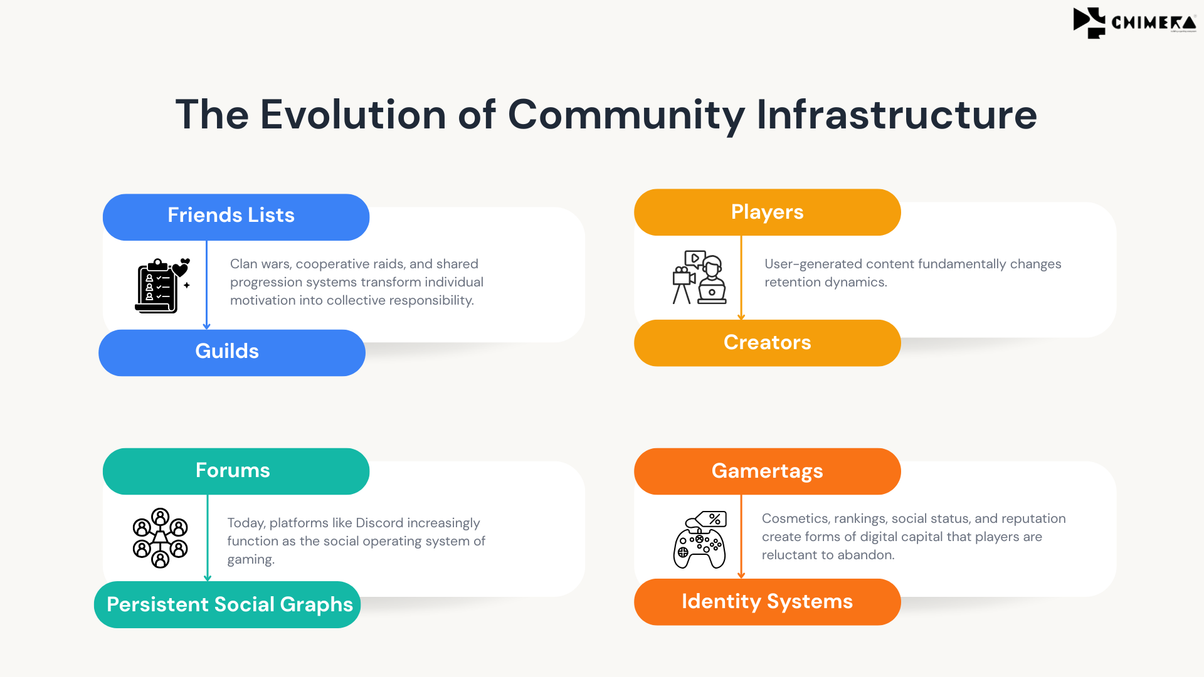
The evolution of community infrastructure illustrates this clearly:
Friends Lists → Guilds
A player who might stop progressing individually often continues playing because their absence impacts the group. Clan wars, cooperative raids, and shared progression systems transform individual motivation into collective responsibility.
Forums → Persistent Social Graphs
Community once existed outside the game.
Today, platforms like Discord increasingly function as the social operating system of gaming. By embedding gameplay directly inside social environments, the distinction between community and game is beginning to disappear.
Players → Creators
User-generated content fundamentally changes retention dynamics.
Instead of studios producing all content themselves, players become contributors. This decentralizes content creation, extends product lifecycles, and creates powerful creator-led acquisition loops.
Gamertags → Identity Systems
Modern gaming increasingly revolves around persistent identity.
Cosmetics, rankings, social status, and reputation create forms of digital capital that players are reluctant to abandon. Leaving the game increasingly means leaving behind part of a digital identity accumulated over years.
Supporting Evidence: The Companies That Solved Community
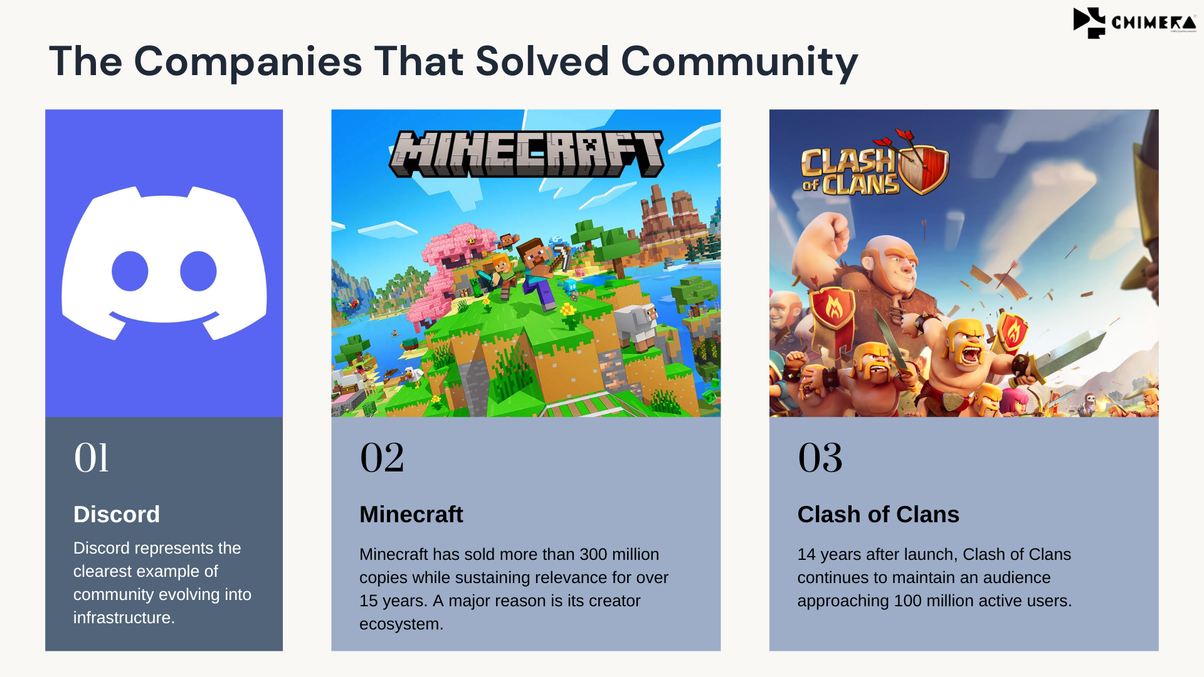
The strongest evidence comes from the industry's most durable platforms. These companies no longer operate purely as games. They operate as communities.
Minecraft
Minecraft has sold more than 300 million copies while sustaining relevance for over 15 years. A major reason is its creator ecosystem.
The Minecraft Marketplace has generated more than $500 million for creators, turning players into contributors and contributors into ecosystem stakeholders. Instead of relying entirely on internal content production, Minecraft continuously expands through community creativity.
Clash of Clans
14 years after launch, Clash of Clans continues to maintain an audience approaching 100 million active users.
Its longevity is not driven primarily by content volume. It is driven by clan infrastructure.
Clan Wars, Clan Capitals, and group progression systems create social obligations that persist long after traditional progression systems would have lost effectiveness.
Discord
Discord represents perhaps the clearest example of community evolving into infrastructure.
Originally a communication tool, it has become the social graph of gaming itself. Increasingly, developers are not pulling players into games. They are pushing games into existing communities.
The result is a fundamentally different retention model where community becomes the primary organizing layer.
Community and Monetization Are Increasingly Linked
Retention and monetization are often discussed separately.
In practice, they are deeply connected. Socially connected players spend more.
Players active within guilds, Discord communities, or creator ecosystems demonstrate approximately 15% higher lifetime value than isolated players.
The reason is behavioral. Cosmetics communicate status and Battle Passes communicate participation.
When players see guild members wearing exclusive rewards or participating in seasonal content, spending becomes part of community participation rather than a standalone transaction.
Community strengthens retention. Retention increases LTV. Higher LTV supports more sustainable businesses.
What This Means for India
India presents a particularly interesting case study.
The country already has one of the world's largest gaming populations, but retention dynamics differ significantly from more mature gaming markets.
Community formation in India is increasingly happening through:
esports ecosystems
creator communities
Discord servers
vernacular streaming platforms
grassroots tournaments
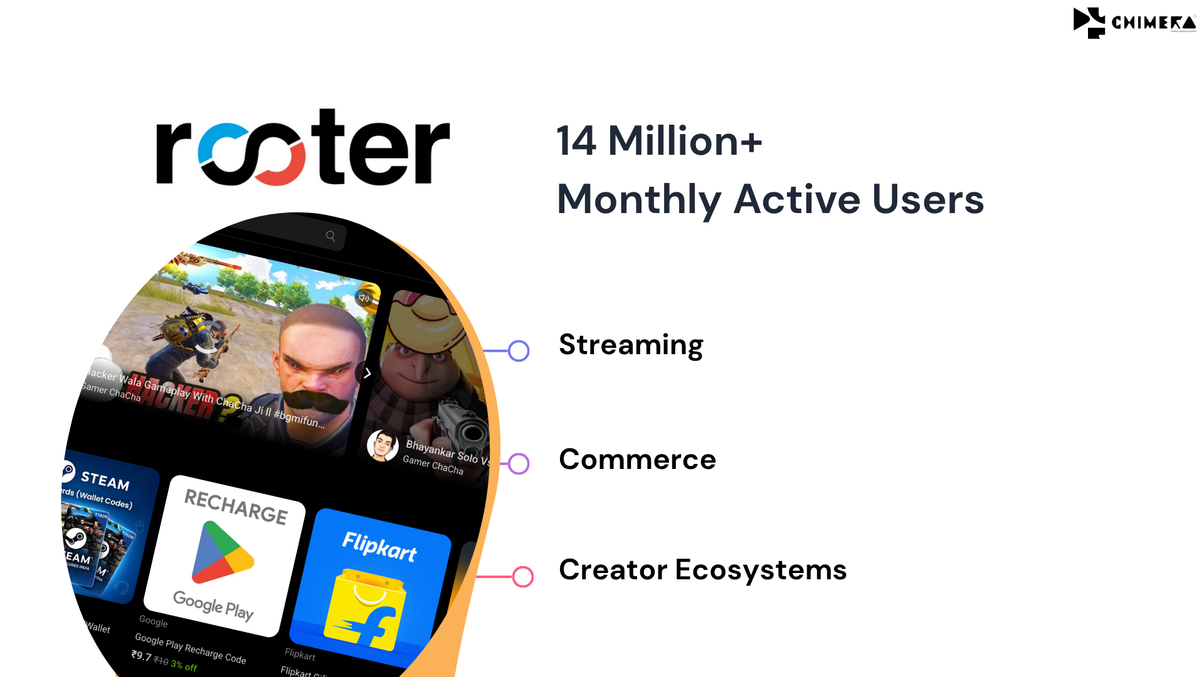
Platforms such as Rooter have evolved beyond content distribution into community infrastructure.
Rooter serves over 14 million monthly active users and has successfully connected streaming, commerce, and creator ecosystems into a single platform.
The contrast between BGMI and Valorant India is particularly instructive.
BGMI's open tournament ecosystem allows players to move from spectator to participant, creating stronger community pathways. Valorant, despite strong demand, still suffers from fragmented community infrastructure, making team formation and progression more difficult.
Audience size alone does not create retention. Community does.
The Solutions: Building Community as Infrastructure
Studios increasingly need to stop treating community systems as optional features added after launch.
They should be designed into the product from the beginning.
The most effective community infrastructure includes:
guild and clan systems
creator programs
user-generated content tools
cross-platform identity layers
community moderation systems
persistent social graphs
Increasingly, these capabilities are being delivered through infrastructure providers such as Pragma, Beamable, Galaxy, and Epic Online Services, allowing studios to build sophisticated social systems without creating them from scratch.
The strongest games create environments where players need each other.
Chimera's Take: Community Is Becoming a Core Infrastructure Layer
We view this shift as overwhelmingly positive.
For years, gaming businesses were evaluated through content pipelines and UA budgets. Increasingly, the more important question is whether a studio is building a social system that compounds over time.
Community infrastructure creates durability. It reduces reliance on paid acquisition. It increases monetization efficiency. It creates network effects that strengthen as player density grows.
Most importantly, it transforms retention from something a studio purchases into something the community reinforces organically.
Community is no longer an engagement layer. It is becoming a retention layer. And increasingly, it is becoming infrastructure.
Stay Ahead of the Curve
As gaming becomes more competitive and player attention becomes harder to earn, retention will increasingly determine which ecosystems compound and which stagnate.
Community infrastructure is one of the most important layers enabling that shift.
Stay tuned for more deep dives as we continue exploring the structural trends shaping the future of gaming, infrastructure, and digital economies.
This is part of how we think about interactive entertainment. Read our thesis, see the companies we back, or tell us what you're building.