
Payments Infrastructure Is India’s Strongest Gaming Stack Layer: But Monetization Infrastructure Is Still Fragmented
India solved payments before it solved monetization.
That sounds counterintuitive at first. Most digital ecosystems move in the opposite direction: commerce layers evolve alongside payment adoption. In India’s gaming ecosystem, however, the transport layer matured first. The behavioral layer is still catching up.
Today, India operates one of the most advanced real-time retail payment systems in the world. The Unified Payments Interface (UPI) processes tens of millions of transactions every month and accounts for the overwhelming majority of retail digital payment volume nationwide.
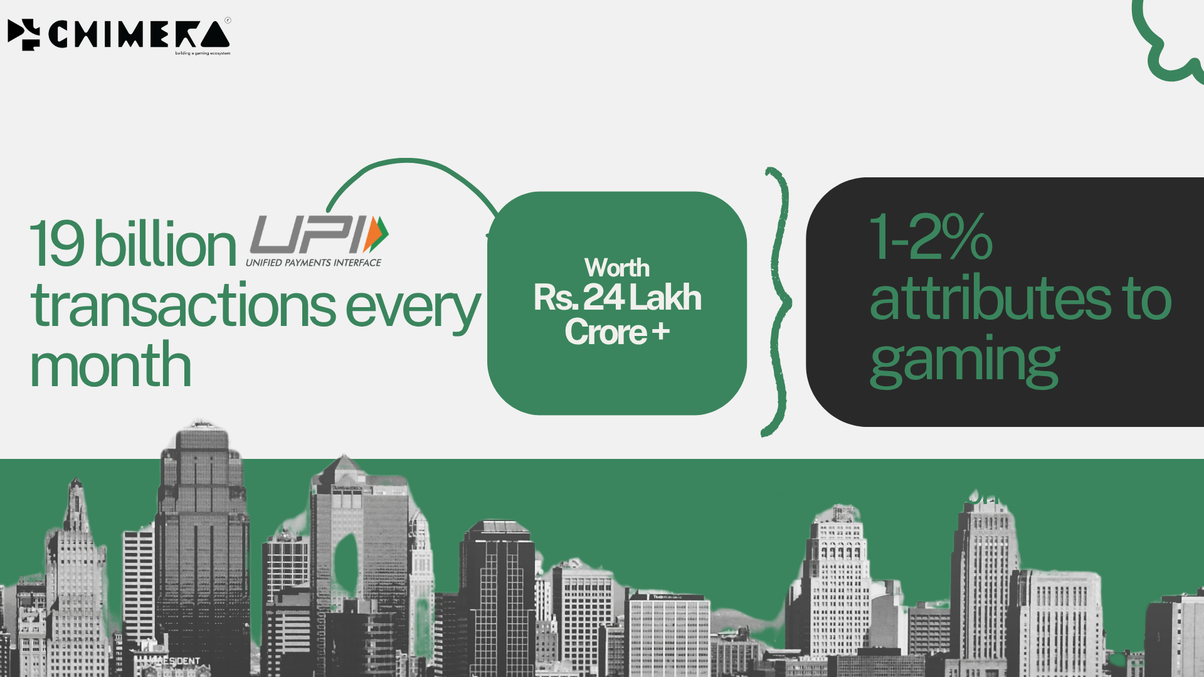
Yet despite this infrastructure advantage, India remains dramatically under-monetized as a gaming market. UPI already processes more than 19 billion transactions every month worth over ₹24 lakh crore, yet gaming still represents barely 1–2% of that volume - a clear signal that payment readiness has scaled far ahead of monetization behavior.
India solved payment rails. It has not yet solved monetization infrastructure.
And the difference between those two layers determines whether engagement becomes revenue.
The Problem: Payment Success Is Not Monetization Maturity
UPI successfully eliminated friction from moving money between users and merchants. It delivers instant settlement, near-zero transaction cost, and interoperability across hundreds of banks and payment apps.
But payment rails only answer one question:
How does money move?
Gaming monetization infrastructure answers a different question:
Why does money move?
Modern free-to-play economies depend on behavioral triggers inside gameplay loops. Purchases are not standalone checkout events. They are moments embedded inside progression systems, LiveOps calendars, social structures, and identity layers.
India’s ecosystem still lacks many of the primitives that enable those behaviors:
wallets that let players store money inside games
shared player accounts that work across multiple titles
systems that manage battle passes and subscriptions automatically
built-in ways for players to support creators or streamers
payments that appear at the right moment during gameplay
plug-and-play payment tools that work directly inside game engines
Without these layers, studios can process payments - but they cannot fully activate monetization.
Supporting Evidence: Why the Monetization Layer Never Emerged
The absence of gaming-native monetization infrastructure in India is not accidental. It is the result of how the ecosystem evolved.
For nearly a decade, real-money gaming dominated revenue across the sector. Fantasy sports and skill-based wagering formats captured between 83% and 86% of total gaming revenues before regulatory changes in 2025.
Those companies required fast payout systems, KYC pipelines, and compliance-grade transaction infrastructure. They did not require:
cosmetic economies
battle passes
progression-linked monetization
LiveOps pricing frameworks
virtual inventory ledgers
As a result, India built financial rails optimized for wagering flows instead of behavioral economies.
At the same time, the country’s historically low ARPU environment reinforced ad-driven monetization strategies.
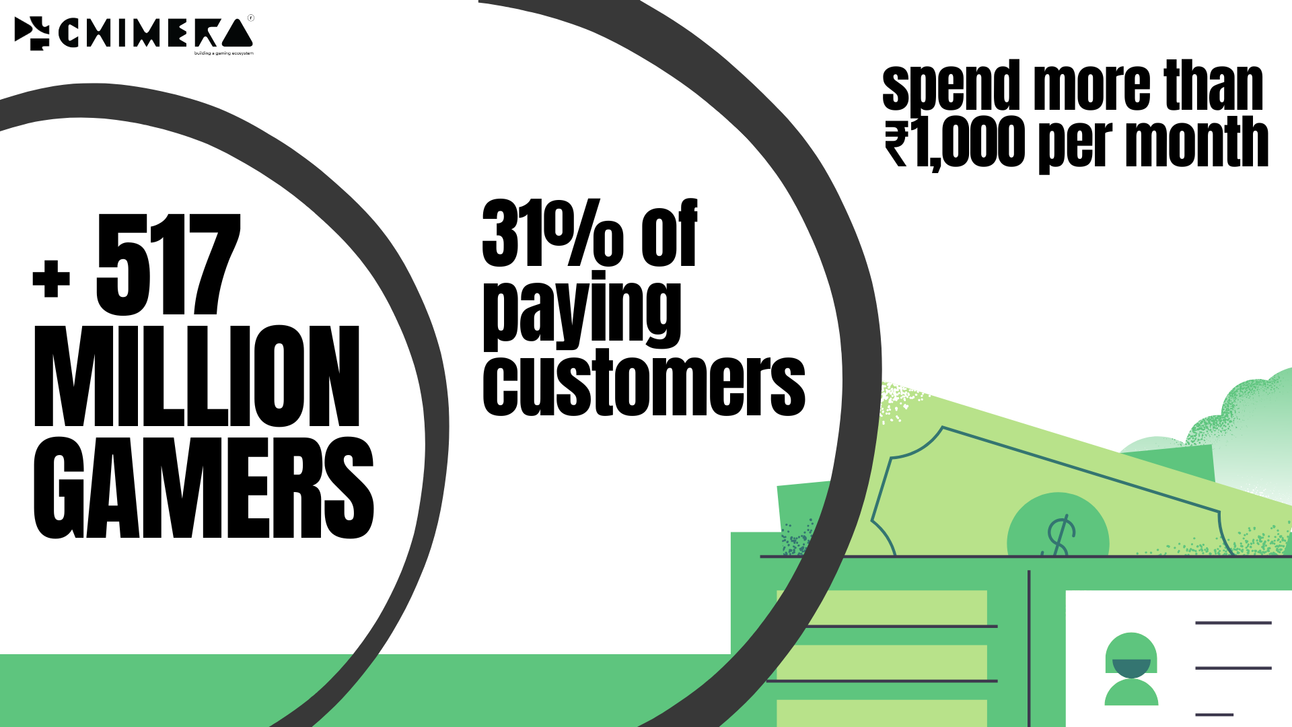
Around 31% of paying gamers in India already spend more than ₹1,000 per month, showing that monetization potential exists - but infrastructure to scale that behavior across the wider player base is still missing
When most users are non-payers, studios prioritize acquisition scale over retention depth.
Regulatory friction also slowed subscription adoption. RBI mandate requirements introduced additional authentication layers that complicated auto-renewal flows for battle passes and recurring entitlements.
Together, these factors created a structural gap.
The Missing Layer: Trigger-Based Monetization Infrastructure
The defining characteristic of modern game monetization is not checkout convenience. It is timing.
Trigger-based payments are activated by gameplay events such as:
leveling up
unlocking seasonal tiers
entering time-limited events
receiving guild upgrades
participating in creator economies
accessing cosmetic drops
progressing through battle passes
These systems require infrastructure that listens to game-state signals and converts them into purchase opportunities in real time.
UPI enables the transaction itself.
But it does not manage:
player identity
inventory ledgers
entitlement delivery
LiveOps scheduling
subscription lifecycle logic
Without those layers, studios must either build custom infrastructure internally or operate simplified monetization systems that leave revenue unrealized.
This is why payment success alone does not translate into LTV expansion.
What Global Markets Solved That India Has Not Yet
In mature gaming ecosystems, monetization infrastructure sits between developers and payment rails.
Platforms like Xsolla, PlayFab, and RevenueCat provide:
systems that handle payments across mobile, PC, and web together
tools that manage in-game currencies and balances
software that keeps subscriptions running smoothly in the background
payments that unlock items instantly after purchase
tools that power seasonal offers and event-based discounts
player accounts that remember purchases across devices
These tools allow studios to treat monetization as a product surface rather than a checkout endpoint.
India does not yet have an equivalent full-stack middleware layer.
Instead, studios typically stitch together:
UPI gateways
app-store billing
reward SDKs
ad networks
This fragmentation slows iteration velocity and limits economy sophistication across titles.
The Solutions: Building India’s Missing Economy Layer
Closing the monetization gap does not require rebuilding payment rails. It requires building infrastructure above them.
Several high-impact opportunities are already emerging.
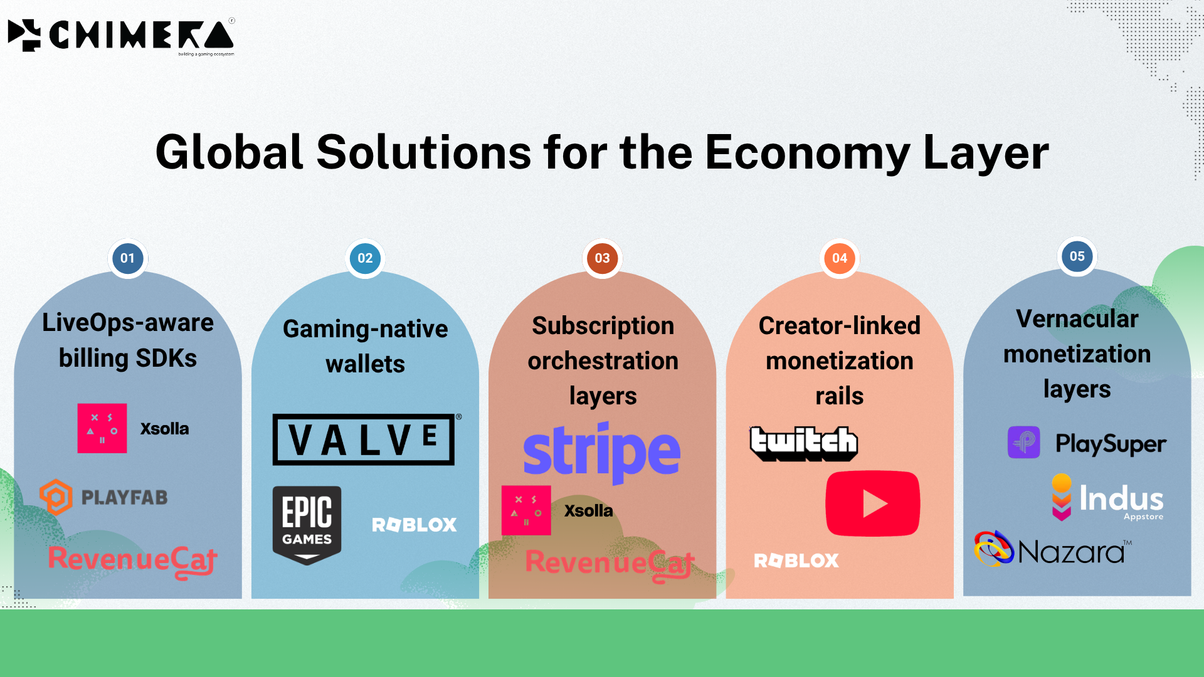
LiveOps-aware billing SDKs
Studios need plug-and-play middleware that connects gameplay triggers directly to UPI payment flows. These SDKs should support contextual offers, event-driven pricing, and entitlement delivery inside active sessions.
Global examples:
India opportunity gap: No full equivalent yet. Closest layers:
Razorpay (transport layer)
Paytm SDK integrations
But these do not provide LiveOps triggers.
Gaming-native wallets
Persistent virtual balances reduce checkout friction and increase impulse purchases. Identity-linked wallets also enable cross-title loyalty systems across publisher portfolios.
Global examples
Valve Corporation (Steam Wallet)
Roblox Corporation (Robux economy)
India opportunity gap
Potential builders:
PhonePe
Paytm
PlaySuper (early behavioral wallet layer)
Still missing: cross-title gaming-native wallet.
Subscription orchestration layers
Battle passes remain one of the most reliable monetization systems globally. Infrastructure that abstracts RBI mandate complexity could unlock recurring revenue models for Indian studios at scale.
Global examples
India opportunity gap
Emerging infrastructure stack:
Cashfree Payments
Razorpay Subscriptions
But neither is gaming-native yet.
Creator-linked monetization rails
Streaming-led economies are expanding rapidly. Native tipping systems and creator-affiliated cosmetics represent an underdeveloped revenue surface in India.
Global examples
Twitch Bits
YouTube SuperChat
Roblox Corporation creator payouts
India emerging stack
Rooter fan engagement loops
Still missing: SDK-level creator monetization inside games.
Vernacular monetization layers
Localized payment UX designed for Tier-2 and Tier-3 audiences can significantly improve conversion across India’s next wave of gaming users.
Early infrastructure builders
Future opportunity:
regional checkout UX
reward-linked economies
tier-2 friendly pricing logic
Together, these layers form the behavioral infrastructure that turns engagement into revenue.
How Studios Can Incorporate These Solutions Today
Until ecosystem-level middleware becomes widely available, India-first studios must treat monetization architecture as part of core production planning rather than post-launch optimization.
This requires three shifts.
First -> monetization logic must be designed alongside progression systems. Battle passes, reward ladders, and seasonal content calendars cannot be retrofitted efficiently after launch.
Second -> studios should prioritize identity persistence across titles whenever possible. Even simple cross-portfolio login layers enable future loyalty loops and bundled economies.
Third -> hybrid monetization strategies combining ads, micro-transactions, and subscriptions should be structured early in LiveOps planning rather than layered incrementally.
Chimera’s Take: India’s Strongest Infrastructure Opportunity Is Still Ahead
We view this gap as one of the most asymmetric opportunities in the Indian gaming stack.
India already solved the hardest part of digital commerce adoption at national scale. UPI created a transport layer that supports instant, low-cost micro-transactions across hundreds of millions of users.
What remains unsolved is the behavior layer.
That creates space for a new category of middleware companies capable of becoming the economic operating system for India-first studios.
Unlike hit-driven content businesses, monetization infrastructure companies scale across portfolios. Once integrated, they benefit from switching costs, transaction volume leverage, and identity graph network effects.
In other words:
The next wave of gaming infrastructure in India will be payment orchestration.
Studios will build games on top of it, publishers will scale LiveOps through it
and creators will monetize communities inside it
This is part of how we think about interactive entertainment. Read our thesis, see the companies we back, or tell us what you're building.