
Global Trends India Can Learn From
India has one of the largest gaming audiences in the world. It has strong technical talent, a growing creator ecosystem, and increasing investor interest. And yet, when it comes to globally scaled studios and enduring IP, India continues to underperform.
This gap is often explained away with surface-level reasons: low ARPU, lack of console penetration, or insufficient capital. But these explanations miss the real issue. The constraint is not demand or talent, it is structure.
To understand how India can move from being a market to being a studio-building ecosystem, it helps to study regions that faced similar constraints and still found ways to scale. Japan, South Korea, Turkey, and Eastern Europe did not succeed by copying Western playbooks or relying on outsized budgets. They succeeded by aligning operating models, capital structures, and ecosystem incentives with their realities.
Their trajectories offer lessons not about what to build, but about how to build sustainably.
Japan: Scaling Through IP Discipline, Not Headcount

Japan’s gaming industry is often viewed through the lens of legacy console giants and iconic franchises. But the deeper lesson from Japan is not nostalgia, it is discipline.
Japanese studios have historically operated with a long-term view of IP. Publishers act as custodians, funding studios across multiple releases rather than treating each title as a standalone bet. This allows teams to think in arcs, refining mechanics, reusing assets, and compounding creative value over time.
Studios like FromSoftware demonstrate what this looks like in practice. Despite global success, they have resisted the temptation to scale teams aggressively. Instead, they prioritize dense specialization, clear creative ownership, and operational restraint. Elden Ring, while massive in scope, was built with significantly fewer people than a typical Western AAA title.
This model reduces burn, limits organizational complexity, and protects creative coherence. It also changes how failure is perceived: a weaker release is not existential if the studio has an IP roadmap and publisher backing.
What Japan teaches India:
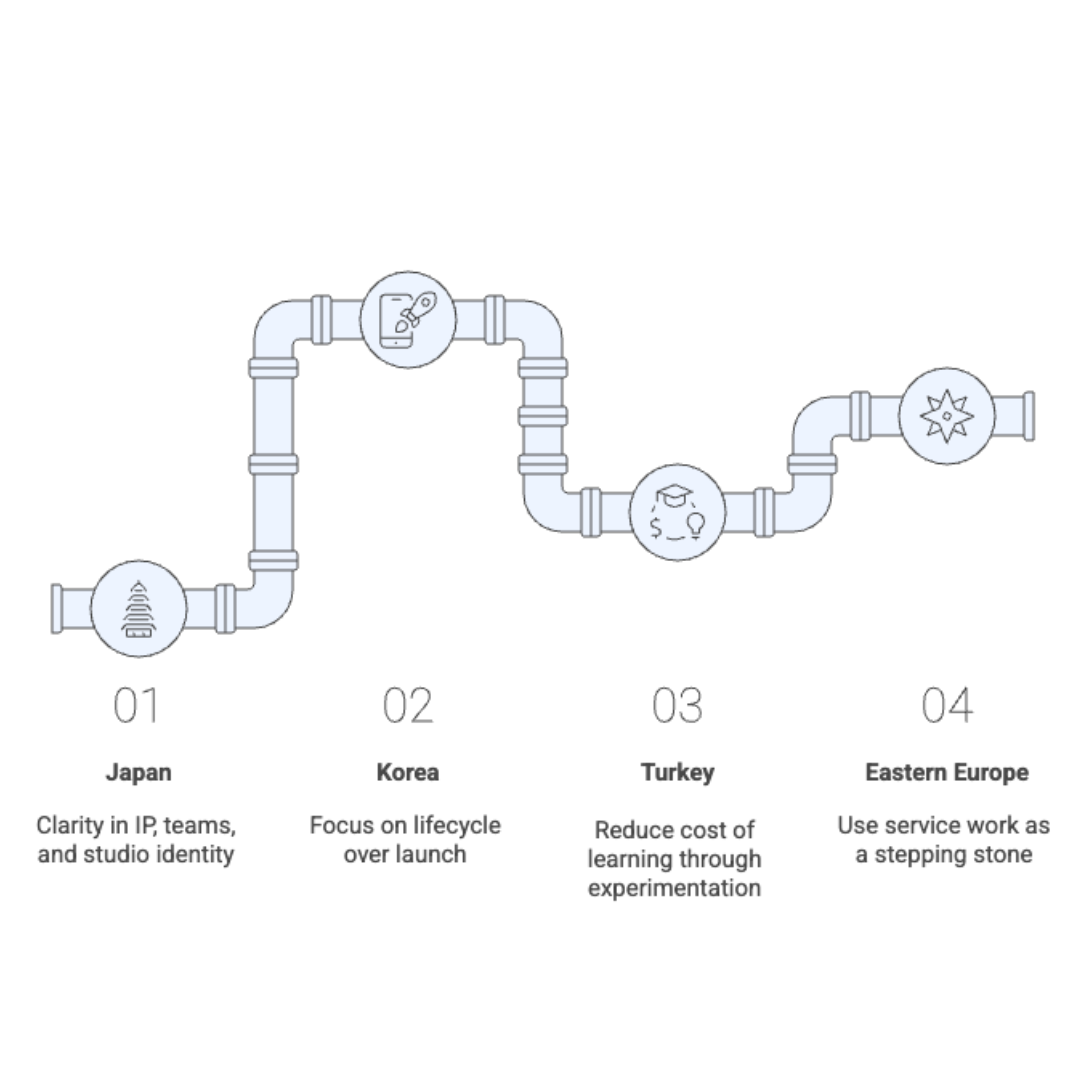
Scale does not come from size alone. It comes from clarity, about IP, about teams, and about what kind of studio you are building. Indian studios chasing headcount growth before establishing repeatable production systems often introduce fragility instead of resilience.
South Korea: Live Operations as an Institutional Capability

South Korea’s success in gaming is frequently attributed to internet cafés, esports culture, or early PC adoption. While those factors mattered, the real differentiator was institutional continuity.
Korea treated gaming as a strategic creative export. Government bodies invested consistently in infrastructure, talent pipelines, and international distribution rather than reacting to short-term trends. When platforms shifted, from PC to mobile, from boxed products to live services, studios adapted without resetting their fundamentals.
At the studio level, Korean developers internalized service-first thinking early. Games were not designed to launch and move on; they were designed to run. Live operations, monetization loops, player segmentation, and post-launch content cadence are treated as core competencies, not downstream optimizations.
This mindset created businesses, not just products. Revenue predictability allowed studios to reinvest in talent, tooling, and new IP without depending on constant external funding.
What Korea teaches India:
If studios are built around launches instead of lifecycles, they remain fragile. Sustainable scale requires treating games as ongoing systems, and building teams that can operate them over years, not months.
Turkey: Capital Efficiency and the Economics of Experimentation

Turkey’s rise in gaming is recent, but its lessons are especially relevant for India.
Without legacy publishers or console ecosystems, Turkish studios focused on mobile-first development. What set them apart was not just genre choice, but capital efficiency. Government-backed incentives reduced the cost of user acquisition and R&D, effectively lowering the price of failure.
Marketing spend, often the biggest risk in mobile gaming, was partially refunded through performance-linked programs. This turned experimentation into a manageable financial decision. Studios could test aggressively, learn quickly, and double down without betting the company on a single launch.
Equally important was specialization. The ecosystem did not attempt to build every kind of studio at once. It concentrated on hyper-casual and casual mobile, created founder recycling through exits, and gradually moved up the complexity curve.
What Turkey teaches India:
You don’t need massive capital to scale, you need to reduce the cost of learning. When experimentation is cheap, ambition becomes sustainable.
Eastern Europe: Converting Execution Excellence into IP Ownership

Eastern Europe followed a different path. It scaled studios by first becoming indispensable execution partners to the global industry.
Outsourcing and co-development created talent density, production discipline, and reliable cash flow. Engineers, artists, and designers learned how large games are built, not in theory, but in practice. Over time, some studios made a deliberate transition: redirecting that expertise toward original IP.
This shift required restraint. Studios standardized tooling, controlled scope aggressively, and accepted that not every project deserved to ship. Killing projects early was normalized. Success came not from volume, but from focus.
Studios like CD Projekt Red and 11 bit studios exemplify this transition. They did not compete on production scale alone; they competed on identity, craftsmanship, and thematic coherence.
What Eastern Europe teaches India:
Service work is not a failure mode, but it must be a stepping stone. Execution excellence only compounds when paired with IP ownership and long-term intent.
What These Regions Share
Despite very different histories, these ecosystems converge on a few principles:
Studios scale when they operate systems, not just ship games
Capital is most effective when aligned to learning velocity, not vanity growth
Talent compounds when studios survive long enough to iterate
Government intervention works best when it lowers risk, not when it dictates outcomes
India struggles not because it lacks ideas, but because too many studios are forced to behave as one-shot ventures.
Applying These Lessons to India
India does not need to replicate any region wholesale. But selective adaptation is essential.
For founders:
Design for retention before reach. Treat live operations as infrastructure. Optimize for speed of learning rather than scale optics. Build studios that can survive imperfect launches.
For investors:
Evaluate studios as systems, not titles. Look for repeatable production loops, operational clarity, and post-launch thinking. Fund learning curves, not just pitch decks.
For publishers:
Develop domestic publishing intelligence grounded in Indian player behavior. Distribution and monetization insights are as valuable as capital.
For policymakers:
Incentivize exports and experimentation. Lower the cost of failure through targeted programs. Avoid genre-specific distortions and blanket subsidies.
Closing Thought
Every region that successfully scaled game studios did so by aligning talent, capital, and operating discipline with local realities. India already has the ingredients.
What it needs now is structure, conviction, and patience.
The shift from potential to permanence will not come from chasing trends late, it will come from building studios early, correctly, and repeatedly.
That is the real game to win.
This is part of how we think about interactive entertainment. Read our thesis, see the companies we back, or tell us what you're building.