
The Talent Scene: If India Has the Builders, Why Don’t We Have the Breakouts?
As of 2025, India is home to approximately 4.3 million software engineers, representing nearly 15% of the global engineering workforce, and produces roughly 1.5 million engineering graduates every year. By scale alone, this should be one of the most formidable technical ecosystems in the world.

On the demand side, the numbers are equally compelling.
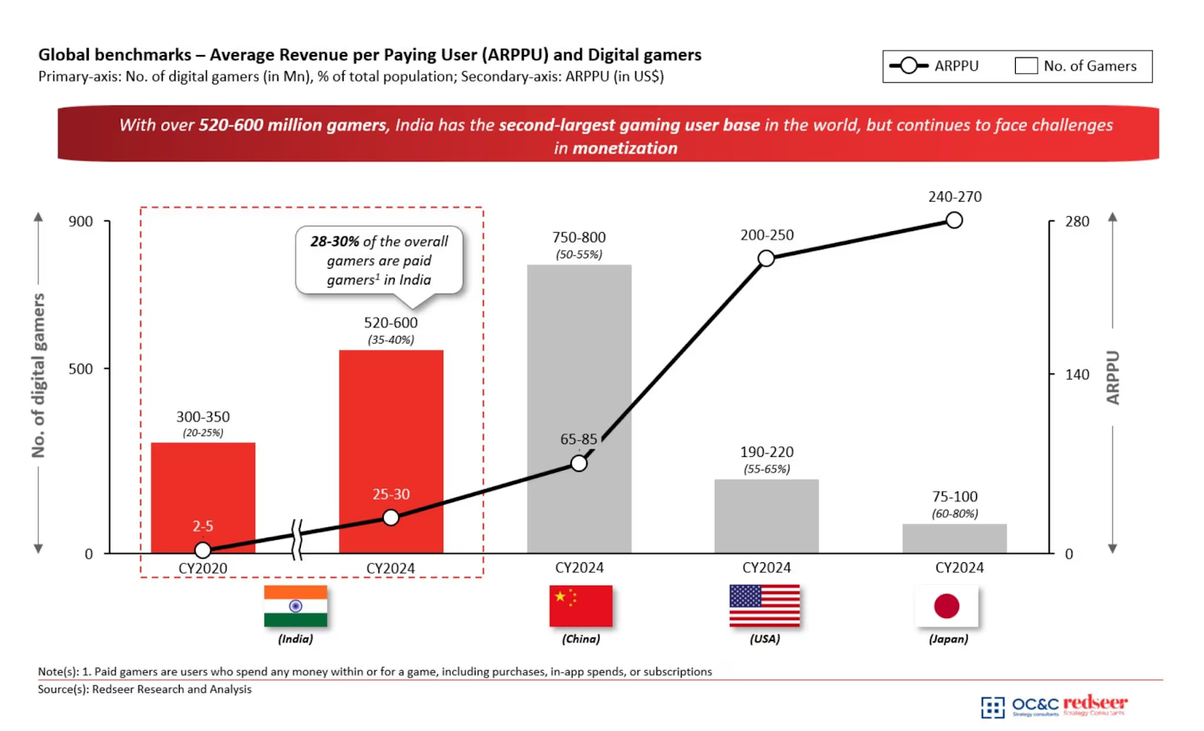
India accounts for over 500 million gamers and nearly 15% of global game downloads. Yet it generates less than 1% of global gaming revenue, with an ARPU of roughly $3 compared to $68 in China and $215 in the United States.
This is the breakout paradox.
India has the builders. It has not yet produced breakout IP at global velocity.
This seems like a structural gap, and that’s where we’re gonna focus today.
Plenty of Builders. Few Breakout Games.
India produces engineers at scale. What it does not yet produce at scale are game operators.
Despite its engineering depth, India accounts for less than 1% of the world’s specialized game development talent. The majority of high-performing engineers are absorbed into Global Capability Centers and enterprise technology roles, where risk is limited and compensation is predictable .
This creates the misalignment.
Breakout games are not built on programming competence alone. They are built on systems thinking around retention, behavioral economics, monetization design, LiveOps cadence, and category ownership.
India’s talent pipeline has historically been optimized for execution against predefined specifications. Breakout IP requires founders who define the system, not just implement it.
This distinction matters more than scale.
The RMG Era Skewed Capital and Talent Allocation
For most of the last decade, Real Money Gaming (RMG) dominated the Indian revenue pool, accounting for approximately 83–86% of total industry revenue prior to the 2025 regulatory ban.

Capital followed monetization certainty.
Talent followed capital.
Top product managers and data scientists focused on maximizing platform fees and transaction volume instead of improving player retention and building strong, long-term IP.
Venture dollars flowed into predictable yield models rather than volatile creative bets.
The result was a structurally skewed ecosystem:
• Monetization expertise concentrated in stake-based formats
• Limited runway for experimental narrative IP
• A generation of operators trained in scale, but not in global game publishing
The 2025 RMG ban created a systemic shock. In the short term, it disrupted revenue pools and destabilized large incumbents. In the long term, it may prove catalytic.
Because ecosystems mature when capital is forced to chase product quality rather than monetization arbitrage.
The Missing Publisher Layer
Every breakout ecosystem has a structural distribution advantage.
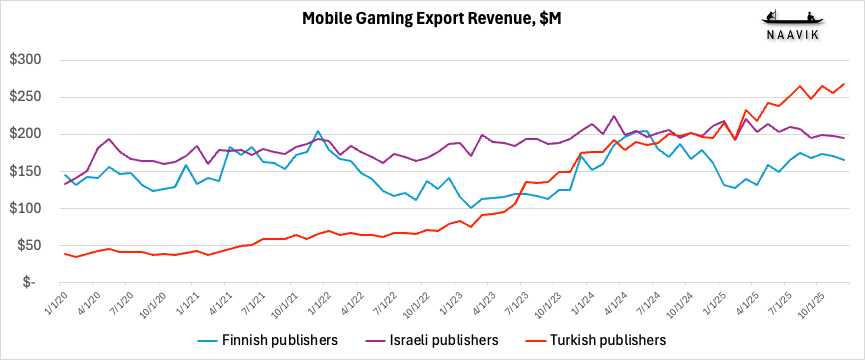
Turkey produced Peak Games and subsequently created a “mafia” flywheel of repeat founders.
Finland institutionalised iteration discipline through Supercell.
Poland built global IP engines around CD Projekt.
South Korea reinforced exports through the Korea Creative Content Agency.
These ecosystems share common structural layers:
• Domestic publishing depth
• Government-backed export incentives
• Capital runway for multiple failures
• Category ownership strategy
Finland’s public investment in gaming has historically returned an outsized economic impact.
India lacks a domestic publisher layer with meaningful user acquisition war chests. As a result, many studios either depend on foreign publishers or remain in service roles supporting global IP.
Without distribution leverage, breakout ownership is difficult to retain.
Breakouts require more than good products. They require sustained visibility at global scale.
The Service Mindset as Structural Gravity
India’s IT services legacy created extraordinary execution discipline. It also created a gravitational pull toward predictable revenue.
Studios such as Lakshya Digital and Dhruva Interactive (acquired by Rockstar Games) built world-class reputations supporting global AAA production. This reflects deliberate specialization in development services, proving that India’s technical execution capability is already world-class.
But service models prioritize stability over IP risk.
When an original title underperforms, many studios pivot back to services to preserve the runway . In ecosystems like Finland, failed launches are treated as learning cycles. In India, a failed first attempt often becomes a terminal event.
Breakouts rarely emerge from single-shot efforts. They require iteration density.
A system that does not fund iteration will not generate breakout velocity.
The Monetization Infrastructure Is Quietly Improving
There are, however, early signs of structural correction.
Average revenue per paying user (ARPPU) in non-RMG gaming has increased significantly, rising from roughly $2 in 2020 to approximately $30 in 2024. Payment penetration through UPI has reduced friction, with around 80% of interactive media consumers using the system.
This shift matters.
The most fragile moment in any free-to-play game is the first successful transaction. India’s digital public rails are reducing that barrier.
For the first time, monetization infrastructure is beginning to align with user scale.
The transition from a “volume market” to a “value market” seems no longer theoretical. It is underway.
Builders vs. Founders
The core issue is not whether India produces technical talent. It does.
The issue is whether the ecosystem produces founders trained in game design, iteration discipline, production scoping, and capital allocation.
Breakout studios globally operate with ruthless iteration frameworks. They prototype early, test frequently, and validate ideas before scaling development. On mobile this may involve soft-launching in controlled markets; on PC and console it often means closed playtests, demos, wishlists, and structured community feedback loops.
Across platforms, successful studios define kill thresholds early. Projects that do not demonstrate traction are stopped before significant capital is deployed.
They validate core signals before scaling investment - retention and monetization curves on mobile; playtest engagement, wishlist velocity, and player feedback on PC and console.
India historically optimized for installs. Breakout studios optimize for compounding player value and long-term engagement.
This philosophical shift is subtle, but it is transformative.
And it is the shift the industry now needs to make.
The Emergence of Second-Time Operators
One of the most promising signals is the emergence of second-time founders transitioning from the RMG ecosystem into non-RMG gaming .
These operators understand:
• High-concurrency infrastructure
• Data instrumentation at scale
• Monetization analytics
• Payment optimization
If this operational rigor is paired with original IP ambition and export-first thinking, the probability of breakout increases materially.
Breakouts are rarely first-time experiments. They are second-time refinements built on prior system exposure.
India is now producing that cohort.
The Structural Question Ahead
India’s first gaming decade was driven by scale. Its next decade must be driven by compounding.
The builders are present.
The users are present.
The payment rails are strengthening.
What remains thin is:
• Domestic publishing depth
• Capital patience for iteration
• Institutionalized retention, engagement and iteration discipline
• Repeat-founder flywheels
Breakouts are not accidents of talent density. They are outcomes of system design and design thinking.
If India aligns capital allocation, publishing leverage, and execution frameworks with its engineering base, breakout velocity will follow.
The question is no longer whether India has builders.
It is whether we are prepared to build the systems that allow them to fail, learn, and iterate long enough to win.
This is part of how we think about interactive entertainment. Read our thesis, see the companies we back, or tell us what you're building.