
Chimera Checkpoint 10: What Makes a Studio Scalable
For most studios, success creates risk.
The industry often assumes that building a breakout game is the hardest milestone to reach. In practice, the more difficult transition begins immediately after the first hit.
Moving from a successful team to a scalable studio requires shifting from creative execution to organizational structure.
Scalability in game development is not just about talent. It depends on whether a studio can turn production into repeatable output rather than one-time success.
Teams that rely on a single title operate inside a hit-driven model, where revenue arrives in spikes and declines just as quickly.
By contrast, scalable studios build systems that allow multiple titles to run across overlapping production and LiveOps cycles.
Predictability in an everchanging industry becomes the real advantage.
Pattern Recognition in an ever changing industry becomes the real advantage.
Why Most Studios Fail at Scaling After Their First Success -
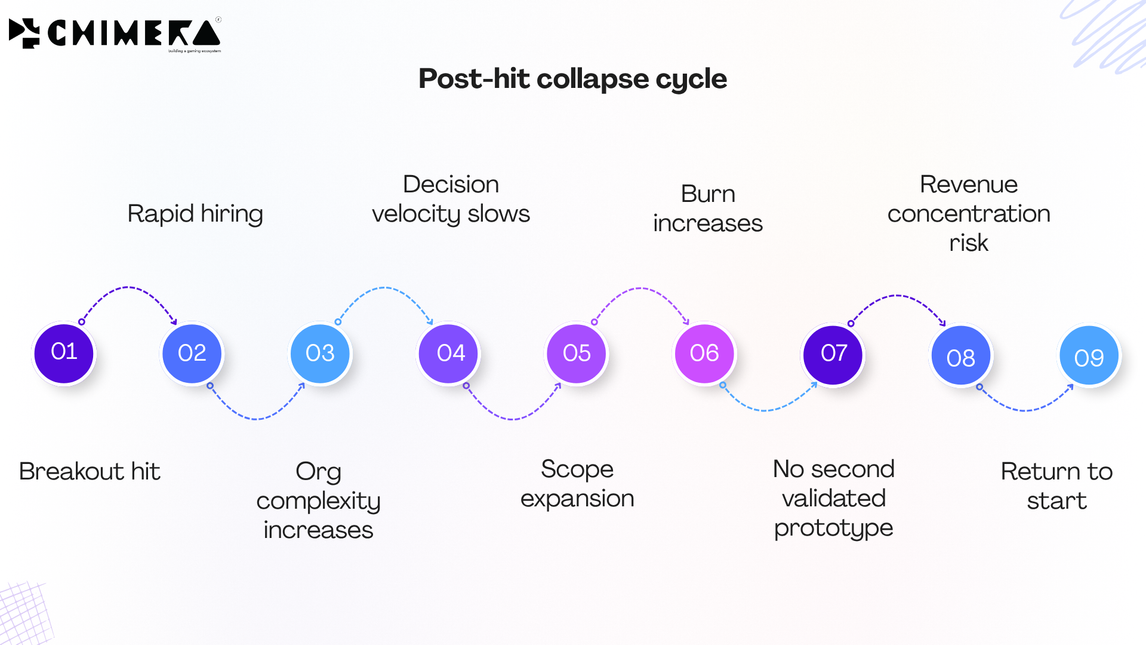
Post-hit collapse is usually the result of a mismatch between organizational growth and production capability.
When a breakout title succeeds, studios often expand headcount quickly in response to revenue inflows and player expectations.
Teams double or triple within a short period, but the supporting infrastructure required to manage that growth does not evolve at the same speed.
Decision-making slows, communication layers increase, and founders often become bottlenecks across both product and operational decisions.
At the same time, capital allocation begins to shift toward ambition rather than validation. Teams invest in higher art, additional platforms, or feature expansion before confirming whether the underlying gameplay loops justify those investments.
Burn rate increases while iteration speed declines.
A second structural problem appears through single-IP dependency. When one title generates most of the studio’s revenue, organizations naturally become more risk-averse.
Instead of funding parallel prototypes, resources are concentrated around sequels or extensions of the flagship title. As engagement declines over time, the studio loses flexibility at exactly the moment diversification becomes necessary.
Industry patterns between 2022 and 2026 show that studios without repeatable systems often reduced headcount by 30–70%.
Finally, many early studios lack formal kill-gate discipline. Without clear decision thresholds tied to retention or monetization benchmarks, underperforming projects continue absorbing runway that could otherwise support experimentation. Over time, this reduces both portfolio diversity and iteration speed.
Studios that grow around a hit often struggle around the next decision cycle.
The Three Axes That Define Studio Scalability
Studios that consistently produce multiple successful titles tend to optimize across three structural dimensions at the same time: hiring architecture, production pipelines, and portfolio strategy.
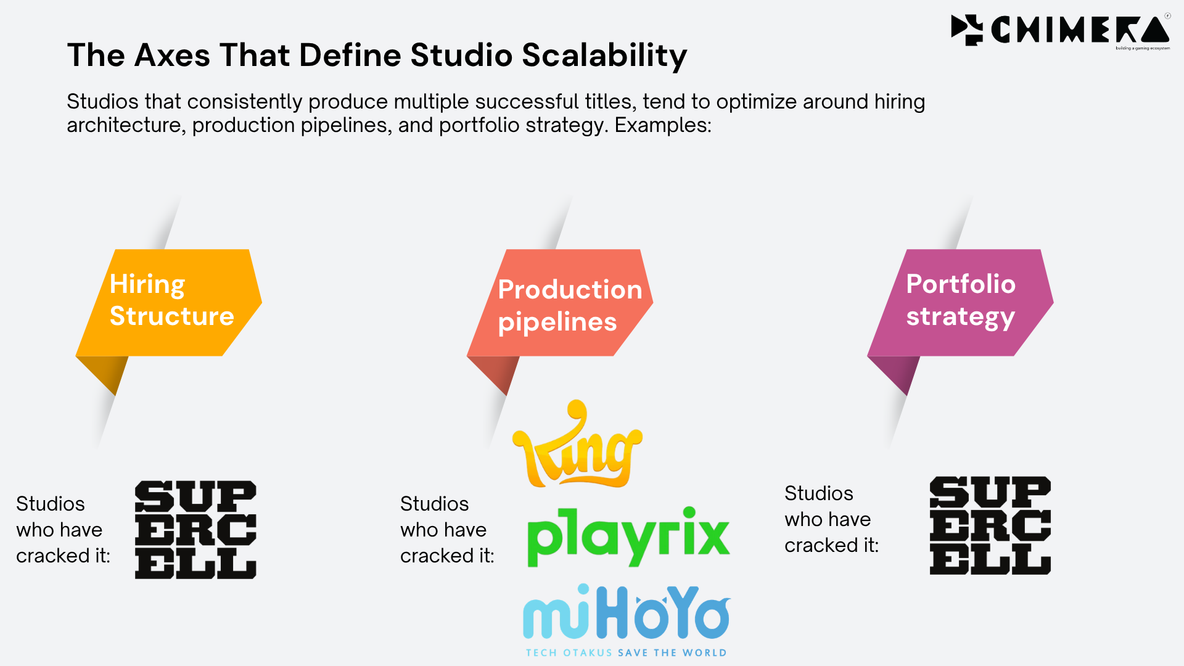
Weakness in any one of these areas limits long-term output regardless of short-term success.
1. Hiring structure: preserving autonomy while enabling coordination
Scalable studios organize around small, cross-functional teams that retain ownership over individual products.
Supercell’s cell-based structure is a well-known example of this approach. Teams of roughly five to fifteen developers operate as autonomous production units responsible for design, iteration, and launch decisions. Management supports these teams by providing infrastructure rather than direction.

The Cell Structure: How Supercell Turned the Traditional Org-Chart Upside Down
This structure helps maintain cultural clarity while preserving iteration speed.
As studios mature, hybrid models begin to emerge. Centralized analytics platforms, LiveOps infrastructure, and shared engine teams support multiple game squads at once. This allows autonomy at the product level while maintaining leverage at the studio level.
The sequencing of hires matters just as much as the structure itself. Early teams typically validate gameplay loops with small prototype groups. Data analysts, economy designers, and LiveOps specialists are introduced only after retention signals justify their impact. Studios that hire specialist roles before validation often increase burn without improving iteration speed .
Hiring discipline therefore becomes a structural capability rather than simply a staffing decision.
2.Production pipelines: compounding infrastructure across titles
Scalable studios treat production infrastructure as a reusable asset rather than something rebuilt for each new project.
Instead of rebuilding tooling for every title, they invest in shared engines, analytics systems, deployment pipelines, and LiveOps dashboards that persist across releases.
Over time, each project improves the pipeline further, reducing the cost and risk of future launches.

Studios such as King and Playrix illustrate this model clearly. Automated testing pipelines, AI-assisted level tuning, and centralized experimentation frameworks allow teams to deploy updates continuously instead of in long cycles. Other studios follow a systems-studio approach rather than a content-factory model.
miHoYo’s six-week content cadence across titles such as Genshin Impact shows how narrative, progression systems, and LiveOps events can function as long-term infrastructure rather than post-launch support layers .
In both cases, production pipelines create compounding advantages across the portfolio.
Iteration speed becomes one of the studio’s most important capabilities.
3. Portfolio strategy: layering experiments around proven revenue
Perhaps the clearest difference between hit-driven studios and scalable studios is how they manage risk.
Scalable organizations rarely depend on a single title. Instead, they operate layered portfolios that combine established live games with mid-stage bets and early prototypes.

Supercell’s internal culture of terminating more than 30 prototypes while maintaining five global hits illustrates this discipline clearly . Paradox Interactive similarly discontinued nearly half of its projects before release while maintaining strong profitability across the titles that launched.
Portfolio thinking changes how failure works inside a studio.
Instead of representing collapse, failure becomes allocation.
Studios that internalize this model shift from a launch-focused mindset to an iteration-focused one.
How Studios Can Incorporate These Systems
Transitioning from a single-title team to a scalable studio requires deliberate sequencing rather than rapid expansion.
1st -> hiring should follow validation milestones rather than roadmap ambition. Prototype teams should remain small until retention signals justify additional specialization. Economy designers and LiveOps operators usually generate the most leverage only after gameplay loops demonstrate stability.
2nd -> analytics infrastructure should be introduced early enough to support iteration but not so early that it replaces experimentation with premature optimization. Even lightweight telemetry systems significantly improve decision quality across retention tuning and feature prioritization.
3rd -> studios benefit from defining kill thresholds before production begins. Retention benchmarks, monetization signals, and engagement metrics should guide continuation decisions rather than intuition alone.
Finally, LiveOps should be treated as a core production layer rather than a post-launch support function. Event pipelines, update dashboards, and A/B testing frameworks reduce the incremental cost of sustaining multiple titles at the same time.
These changes transform output from episodic to compounding.
Chimera’s Take
From our perspective, the shift toward scalable studio architecture represents an important transition underway across the gaming ecosystem.
Historically, studios were evaluated primarily on the strength of their flagship titles. Increasingly, they are evaluated on their ability to produce multiple titles with predictable iteration speed and retention stability.
This transition changes how risk should be interpreted at both founder and investor levels.
Studios that build small-team autonomy, shared infrastructure pipelines, and portfolio-level decision frameworks are not simply increasing production capacity. They are turning themselves into organizations capable of compounding output over time.
Importantly, this shift reduces reliance on founder heroics as the primary driver of success. Instead, it embeds decision-making inside telemetry systems, LiveOps frameworks, and kill-rate discipline.
The next generation of breakout studios will be those that build the most repeatable systems.
We will continue exploring structural shifts across production systems, talent formation, and distribution infrastructure in. Stay tuned for more ecosystem deep dives.
Sources:
https://www.roadtovr.com/cloudhead-games-lay-off-70-percent-staff-2026/
https://www.polygon.com/24177290/video-game-industry-layoffs-studio-closures-record/
https://mobilegamer.biz/how-king-balances-human-and-ai-powered-design-in-candy-crush-saga/
This is part of how we think about interactive entertainment. Read our thesis, see the companies we back, or tell us what you're building.