
Chimera Checkpoint 7
India is building games inside a system it does not control.
By volume, the country is already one of the largest gaming markets in the world. India now has nearly 500 million players. and consistently ranks at the top of global mobile download charts. The surface metrics suggest scale, momentum, inevitability.

And yet, Indian studios capture only a sliver of the value created in this system. Roughly 6% of player spend flows back to domestic developers. More than 40% accrues to publishers in the United States and China.
This is not a talent gap. It is not a creativity gap. It is not even primarily a funding gap.
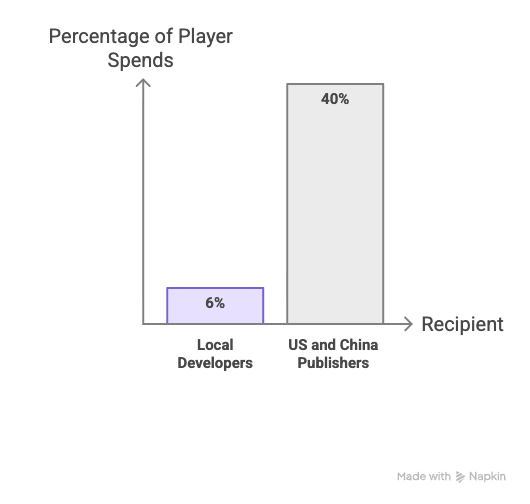
It is a structural gap.
India today functions like a back office for the global games industry. We supply art, engineering, and execution. We train strong builders. What we do not own are the systems that decide what gets discovered, what gets scaled, and what becomes a business. The result is not just low revenue.
Every studio starts from zero. Every launch is existential. Every failure is the end of the company.
This article makes a simple argument: India will not build a real game industry by shipping more games. It will build one by building a domestic publishing layer that makes studios survivable, learning repeatable, and progress cumulative.
Everything that follows, mobile, PC, console, funding, pricing, platforms, flows from this missing piece.
India’s Game Industry Has a Survivorship Problem
India does not have a game development problem. It has a game survival problem.
Every year, hundreds of teams across the country begin building games. A small number actually ship it. A very small number see any commercial signal. An even smaller subset becomes stable, repeat studios. Anyone who has spent time in the ecosystem over the last decade has seen the same cycle repeat: one ambitious project, one hard launch, and then either services work, layoffs, or shutdown.
Not because the teams are bad. Not because the ideas are bad. Often, not even because the games are bad.
India produces good engineers, good artists, and increasingly, decent games. What it does not produce are studios that can afford to learn in public more than once. In mature markets, failure is part of the pipeline. In India, failure is usually the end of the company.
That is not cultural. It is not motivational. It is infrastructure.
Games Don’t Launch. They Enter Systems.
A game does not succeed or fail on launch day. It succeeds or fails inside a system that most Indian studios do not control and barely understand.
Consider a small team in Pune, Indore, or Kochi. 3 or 4 people. Two years of work. When they ship, “launch” is not a milestone. It is a cliff. If the game does not immediately show signs of life, the company is over. There is no budget for iteration. No time for a second try.

Now compare that to a publisher-backed studio elsewhere. For them, launch is the beginning of a process: soft launch, data, tuning, relaunch, scaling. The difference is not talent. It is access to the system.
Every successful game moves through the same pipeline. It must be discovered, then downloaded, then retained, then monetized, and then operated over time. None of these stages are automatic. Each is its own craft, with its own tooling, data, and cost.
In mature markets, studios are not expected to carry this alone. Publishers fund soft launches, buy the first users, run tests, handle QA and certification, negotiate with platforms, and absorb the hidden operational work that never shows up in postmortems.
In India, the same work is pushed onto the studio.
A tiny team is forced to finish the game, learn user acquisition, interpret retention charts they have never seen before, test across thousands of devices, deal with compliance and platform processes, and still ship, while running out of money.
Most games do not fail because players hate them. They fail because the team never gets a real chance to run the process.
The Mobile Reality: Scale That Doesn’t Convert to Survival
Every Indian game studio is told the same thing: mobile is your biggest advantage. In practice, mobile is where most of them run out of runway.
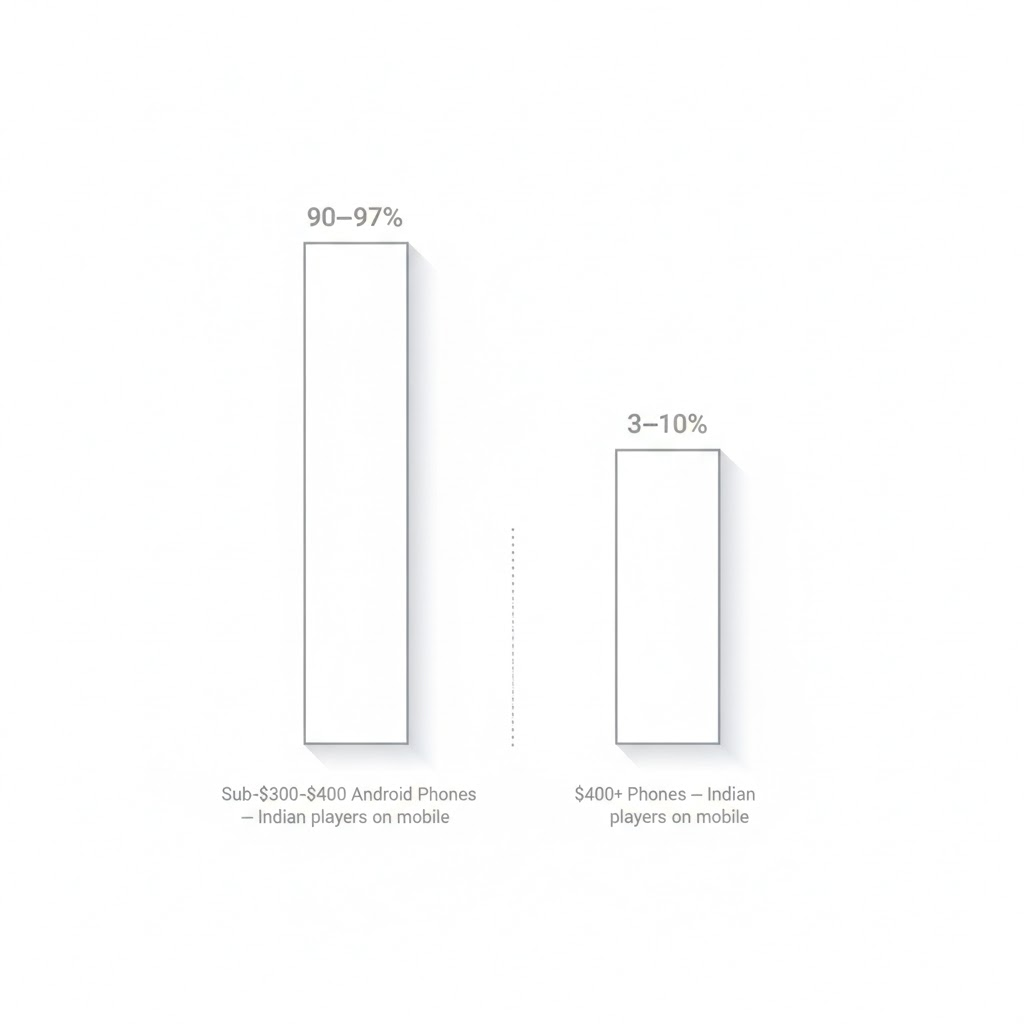
India is a mobile-first country. Roughly 90%-97% of Indian players are on mobile, and India sits at the top of global download charts. But this is not a forgiving market. It is an attention market ruled by store algorithms.
On Google Play or the App Store, you do not launch into an audience. You launch into a ranking system. These systems respond only to early signals: how many users you bring in, how long they stay, and whether any money shows up.
For a small Indian studio, this creates an impossible loop. You need tens of thousands of real users just to know whether your game works. To get those users, you need marketing money. Without those users, the store never shows your game to anyone else.
So most Indian mobile games do not fail. They simply never get a real chance to be evaluated.
This is compounded by hardware reality. The majority of Indian players are on sub-$300–$400 Android phones. Thermal throttling, memory pressure, and unstable networks are normal. A crash rate that would be annoying in Western markets is fatal here. Ratings collapse. Retention collapses. The algorithm buries you.
Small teams cannot realistically test across thousands of device combinations, run real user acquisition experiments, and operate a live game while still finishing production. So in practice, Indian mobile studios are not competing on design or product quality. They are competing on who runs out of money last.
In mature markets, this is where publishers step in. They fund early cohorts, run structured soft launches, centralize QA and device testing, and make decisions with data: kill early or double down.
In India, without this layer, every release is a company-ending bet.
The PC and Console Reality: Talent Without Ramps
India has developers who can build PC- and console-quality games. What it does not have is a system that lets them survive making more than one.
Almost every serious Indian premium game has the same story. A small team works for three, four, sometimes five years. People take pay cuts. Founders put in personal money. The goal becomes simple: just ship the game.
And that is where things usually go wrong.
Most first-time founders underestimate how much of a premium game’s success is not the game. Store positioning, wishlists, timing, press, creators, platform relationships, regional pricing, and launch sequencing are full disciplines of their own. In India, most teams either do not know this or discover it far too late.
So they self-publish. They spend years building and weeks thinking about marketing. Then they launch into silence.
The problem is not just audience size. It is access, process, and know-how.
To ship properly on consoles, you need dev kits, platform relationships, and approvals. In India, that usually means customs, delays, and waiting. Certification is its own discipline, and a failure sends you back in the queue. Porting, QA, localization, and store management are full production pipelines by themselves. Even hardware movement and physical distribution are slowed by BIS and import processes.
In mature markets, studios are not expected to handle any of this alone. Publishers secure the dev kits, run certification, manage platform relationships, fund ports, plan marketing, and carry go-to-market risk.
In India, studios try to do all of this themselves, and they only get to try once.
That is why Indian premium games feel like once-in-a-lifetime projects instead of the first step in a catalogue.
What Publishers Actually Do
If you think publishers exist to write cheques, you have probably never tried to ship two games in a row.
In every mature market, publishers are not passive financiers. They are system operators. They decide when a game is actually ready for market. They test positioning, pricing, and onboarding. They manage discovery, featuring, and user acquisition. They plan launch sequencing, run live operations, and handle platform relationships, compliance, and certification.
Just as importantly, they kill more games than they ship.
This is not a waste. This is how learning becomes non-fatal.
The most valuable thing a real publisher carries is not money. It is a memory. Knowledge about what worked, what did not, what a bad retention curve looks like, what a fake wishlist spike looks like, what kind of trailer converts, and what kind of launch window quietly kills you. That knowledge compounds across projects. That is why second games are almost always better than first games when a serious publisher is involved.
Indian studios, by contrast, are strong at building. Engineering, art production, execution, the craft side is no longer the bottleneck. Where they struggle is everything around the game: market sequencing, product psychology, retention and monetization pacing, go-to-market strategy, and post-launch operation. Most teams only encounter these problems after they have already committed years of work.

Worse, they are structurally unable to do what mature ecosystems take for granted: run multiple failed experiments, survive a soft launch that says “not yet,” or carry legal, compliance, and payment overhead while iterating.
So the real job of a publisher is not to pick winners. It is to make experimentation survivable, centralize market and platform knowledge, and turn one-off teams into repeat shippers.
This is infrastructure work, not hit-making.
India’s Real Bottleneck
Every country that has built a real game industry did it by building a publishing class, not just a collection of studios.
Japan built long-term IP custodians. Korea built industrial-scale live operations. Turkey built fast, cheap testing machines. Eastern Europe built paths from services to owned products.

India’s constraint is different.
India is no longer short on teams. There are more capable developers today than at any point in the past. What India is short on is operators, people who have shipped many games, who have managed portfolios instead of single projects, who know when to kill early and when to double down, who know how to grow a game after launch instead of just celebrating launch.
RMG companies may evolve into parts of this. Large service studios may evolve into parts of this. But today, the middle layer, the layer that turns many attempts into a learning system, is missing.
This is where India actually has an advantage. The cost of running an experiment in India is low. For the cost of one mid-sized Western production, you can fund several Indian prototypes. But this only works if someone owns the portfolio instead of just the projects.
Otherwise, you do not get a learning system. You just get brave failures.
The Ecosystem India Needs

The problem is not that Indian games are not good. The problem is that the system does not let teams build more than once. Success does not compound. Lessons are lost. Teams vanish.
The ecosystem India needs is one where repetition is normal. Where making a second, third, and fourth game is expected, not exceptional. Where studios survive weak launches, learn from data, and improve iteratively. Where knowledge about marketing, retention, monetization, and platform requirements is shared and institutional, not lost with the first team that burns out.
In this ecosystem, studios design for iteration, not one-off perfection. Launch is phase one, not the finish line. Publishers operate like infrastructure. They manage QA, live ops, device testing, platform relationships, compliance, and user acquisition. They carry risk so studios can experiment safely. They run portfolios so learning compounds across games.
The outcome is concrete. Multiple Indian publishers managing cross-platform portfolios. Studios shipping several games and improving post-launch rather than disappearing. Domestic expertise in marketing, pricing, platform relationships, and lifecycle management that no longer needs to be reinvented for every launch. Indian titles occupying durable positions on global storefronts, not as one-offs, but as part of a repeatable, institutional system.
India already has the talent, ambition, and market.
What it lacks is the layer that turns effort into momentum.
With domestic publishing infrastructure, India stops being a market games are sold into and becomes a system where games are built, scaled, and sustained.
That is the shift that matters.
This is part of how we think about interactive entertainment. Read our thesis, see the companies we back, or tell us what you're building.