
The Rise of Publishing Intelligence
In 2025, the Google Play Store has grown to host over 278,000 gaming apps, with thousands of new games being released every month.
Most of these titles did not fail in the conventional sense. They were never seen. Failure implies a test that ran and produced a negative result. Most of these games never ran a test at all.
The constraint has moved. The question is no longer whether a game can ship. It is whether the team building it understands what shipping into this environment actually requires.
The Market Filled. The Rules Changed.
For most of the industry's history, the constraint was access. Publishing relationships and distribution agreements. Those barriers are now gone.
Mobile game releases have surged exponentially over the last decade. While overall download volumes remain massive, top-chart penetration has tightened, with fewer new titles breaking through each year.
The result is structurally predictable: more games compete for the same aggregate attention. When supply expands, and demand stays flat, price, in this case, the cost of acquiring that attention, rises. This is the Market trend that’s at hand.
Attention Is Now a Cost Structure
Gaming UA spend now runs approximately $25B annually. Cost per install sits in the $3–5 range across major platforms. Those numbers are outcomes of a structural shift.
More creatives are being produced. More impressions are being purchased. Studios are spending more to reach equivalent outcomes. Every dollar deployed in this environment carries real capital risk, a weak product can now burn through a runway before the data is legible.
This is what happens when UA stops being a distribution function and becomes the primary cost of finding out whether a product works.
The Retention Window Is Shorter Than Teams Assume
Breaking through does not solve the problem. It creates the next one.
Mobile D1 retention averages approximately 27%. D7 sits at roughly 8%. By D30, fewer than 3% of users remain active. Mobile game lifecycles consistently show this structural shape: sharp peaks, rapid decay.
This is not a content quality problem. It is a behavioral pattern that defines economics. When retention falls this fast, the payback window compresses. A product that cannot demonstrate depth in early cohorts will not be a different product at month three. The signal is already in the data.
Most teams underestimate how early the outcome is determined.
The Industry Responded by Moving the Decision Earlier
When discovery is uncertain, acquisition is expensive, and retention decays quickly, the rational response is to push the evaluation upstream. That is what happened.
Across platforms, teams began testing earlier, evaluating continuously, and scaling selectively. The cost of learning late became prohibitive.
Supercell as a structural case study: Supercell's model is routinely described in terms of its hit rate. That framing misses the point. The defining feature is not what succeeds, it is when decisions are made. Of every ten games Supercell builds, seven are killed in prototype, two are killed in testing, and one reaches global launch. Decisions happen early, and they do not stop after launch.

Squad Busters reached ~75 million downloads with strong early retention. It was shut down. The data showed the product lacked the long-term depth required to sustain retention and monetization at scale. That call is only executable if the measurement system is built to surface it ,and if the organization has the discipline to act on it.
Most successful mobile titles go through a controlled release before global rollout. Soft launch way through which teams generate the 3 data points that determine whether to proceed: retention shape, monetization trajectory, and CPI-to-LTV ratio.
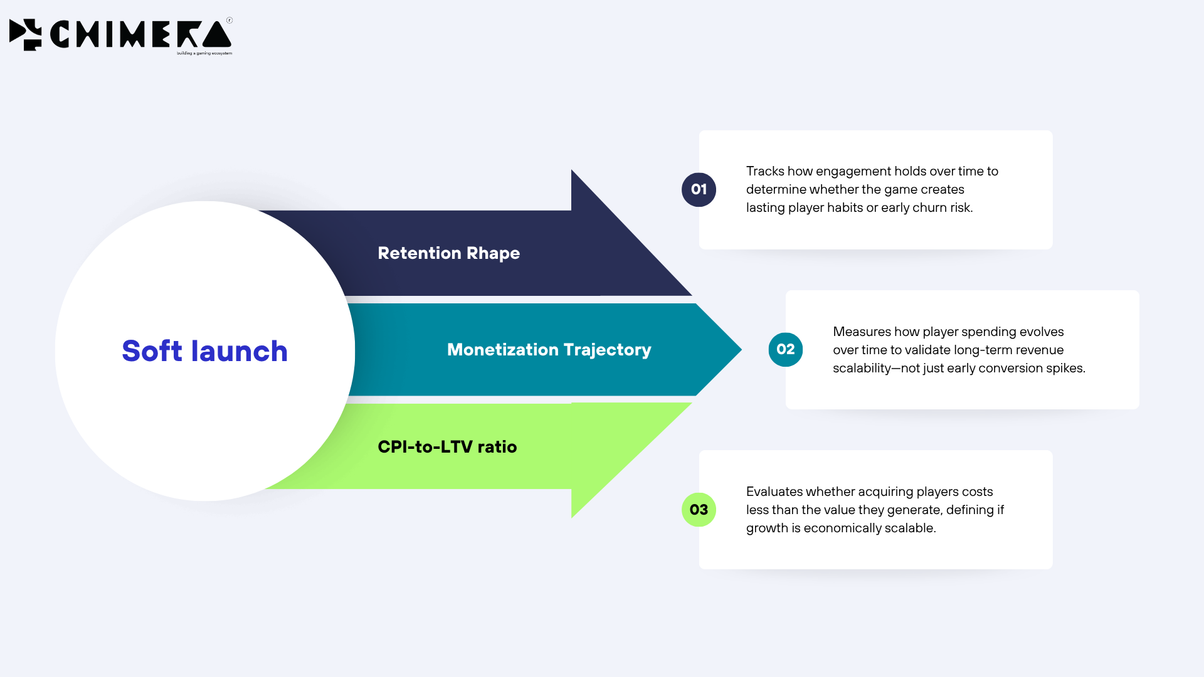
Without clarity on all three, capital deployment into global UA is structurally unjustified.
There is a strong, measurable relationship between app store pre-registration volume and early launch performance on mobile. Games with large pre-registered bases perform predictably. What this means structurally: by the time a game launches, its distribution outcome is largely pre-determined by the momentum built during development.
UA Moved Into the Build Phase
The more consequential structural shift is this: marketing is no longer a post-development function.
Studios now run small UA campaigns during development, limited budgets, specific geographies, controlled cohorts, sometimes $500 to $1,000 per day in spend. The objective is signal generation. Who shows up, stays and spends.
That information feeds back into product decisions. Creative direction, monetization design, session structure ,all of it becomes responsive to early cohort behavior. UA is now part of the iteration loop.
This changes the cost structure of building. Teams that treat UA as a launch function will consistently discover product problems after they have become expensive.
What This System Rewards
Indie and smaller studios have outpaced large publishers across several market segments. The structural explanation is straightforward: smaller teams carry lower cost per experiment, move through iteration cycles faster, and can stop without catastrophic consequence. In an environment where the pace of decision-making compounds into long-term advantage, that structural lightness is durable.
Larger studios face the inverse problem. More capital at stake per decision creates organizational friction around the very discipline, fast killing, early evaluation, ruthless prioritization, that the market now requires.
Implications for Founders
Several decisions get made wrong in the current environment.
On testing: Soft launches and early UA campaigns are not optional validation steps. They are the mechanism by which the capital efficiency of a product becomes legible. Running without them is not moving fast ,it is deferring risk into the most expensive phase of the product lifecycle.
On retention: D1 and D7 retention are not vanity metrics. They are the primary input into whether the LTV/CAC structure of the product is viable at scale. Teams that cannot hit 25%+ D1 retention as a baseline should not be optimizing acquisition ,they should be rebuilding engagement loops.
On killing: The structural cost of building too long without signal is higher than the cost of killing early. Teams that lack pre-defined kill criteria will consistently over-invest in products the data has already condemned.
On UA during development: Small spend, early, even $500 a day into a controlled cohort ,generates the behavioral data that shapes a better product. This is not a marketing function. It is a product function with marketing mechanics.
The Structural Takeaway
The compounding advantage belongs to teams that have internalized one structural truth: the outcome of most games is visible in early data, long before the broader market sees it.
The teams that act on that data ,early, dispassionately, with the discipline to stop when the signal says stop ,will outperform not because they make fewer mistakes, but because they make them cheaply and learn from them quickly.
That is what publishing intelligence actually means - A system built to see clearly, decide quickly, and allocate capital only where the data has already provided a case.
This is part of how we think about interactive entertainment. Read our thesis, see the companies we back, or tell us what you're building.