
Narrative Play: How Cultural Stories and Heritage Are Powering the Next Wave of Games
The global games market stood at $299 billion in 2024 and is projected to hit $601 billion by 2030. The space is crowded, capital-intensive, and unforgiving. Most titles fail quietly; a few succeed spectacularly. What separates the winners is no longer just graphical fidelity or technical polish; it is emotional resonance.
The next era of breakout games will be defined by how well they leverage cultural stories and heritage. These narratives blend timeless folklore, collective memory, and lived tradition with interactive mechanics, creating experiences that feel both deeply personal and globally scalable. When handled with authenticity, they translate directly into player retention, lifetime value, and transmedia optionality.
Put simply: storytelling is no longer a creative luxury; it’s a moat.
What We Mean by Narrative-First Games
Narrative-first games are titles where story drives the loop. That can mean:
Historically, many games prioritised pure mechanical engagement. Today, a distinct sub-genre has emerged: narrative-driven games, defined as those where story elements, such as plot, character development, and world-building, play a central role in gameplay, often prioritising emotional engagement. Mythology-inspired games specifically draw from ancient lore, legends, and cultural traditions, reinterpreting them through interactive lenses.
This trend gained significant velocity through successful franchise reinvention. For instance, the God of War series revitalised itself by shifting its core focus from revenge-driven action to a poignant story of fatherhood set within Norse mythology.
This pivot demonstrated that reinterpreting myths can profoundly transform a franchise. The category scope today is broad, spanning mobile, PC, and console platforms, and includes sequels, reboots, and lucrative transmedia tie-ins.
A cinematic epic (God of War, The Last of Us) where narrative is the central hook.
A roguelike (Hades) where each death unlocks story beats.
A regional indie (Raji: An Ancient Epic) embedding traditional art into mechanics.
Even mobile hits (AFK Arena, Summoners War) that use lore drops to maintain fan communities.
The spectrum spans PC, console, and mobile, but the throughline is intent: players return not only to play, but to see what happens next.
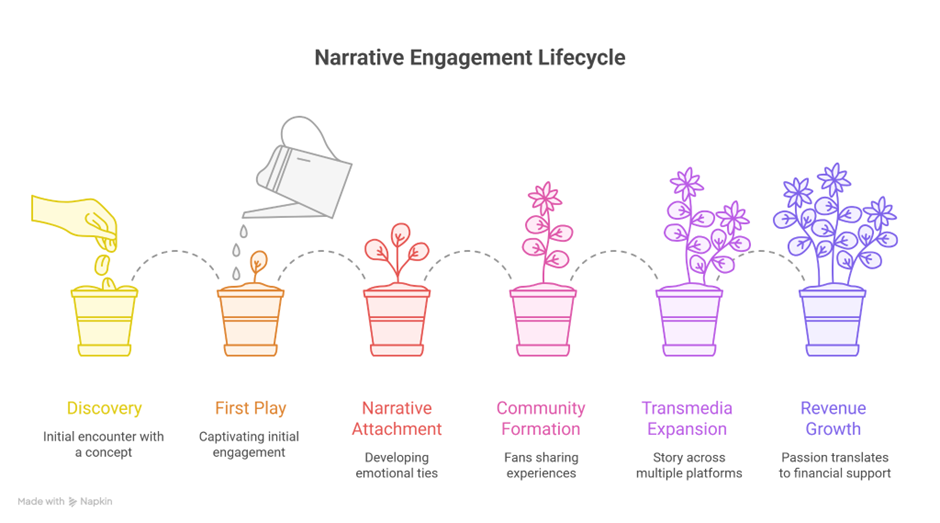
Why Stories Move Metrics
Psychological Drivers
Narratives work because they sync with how the human brain processes emotion:
Narrative transportation: players forget time and space while absorbed in a story.
Parasocial bonding: emotional ties with fictional characters mirror real relationships.
Mirror neurons: players literally “feel” characters’ emotions; grief, joy, triumph.
Loss aversion: when a beloved character suffers, the pain feels personal, amplifying engagement.
Nostalgia loops: revisiting cultural stories (like Norse sagas in God of War or Indian epics in Raji) creates comfort and belonging.
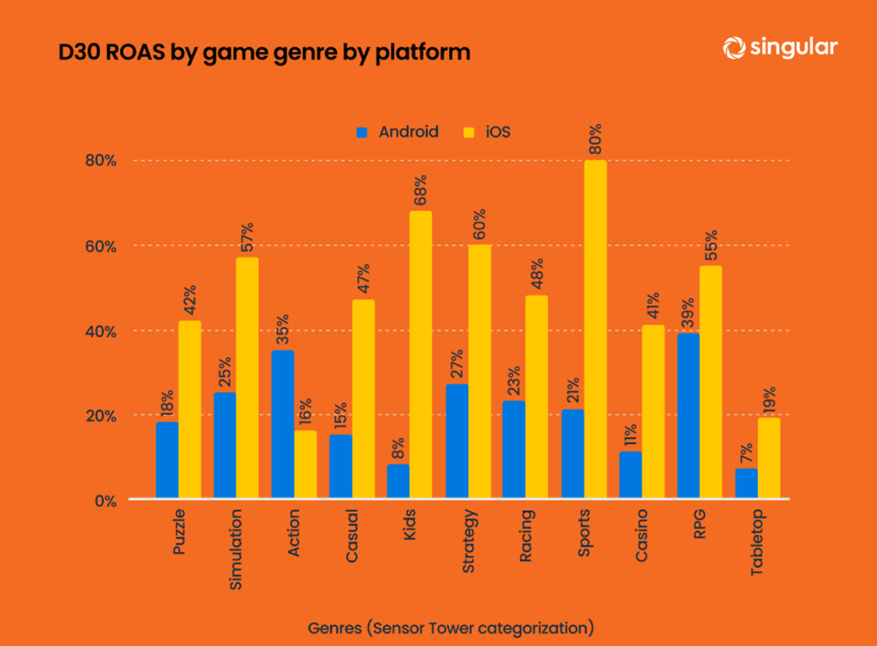
This isn’t just theory. Narrative-heavy RPGs retain 9.8% of players by Day 7, compared to 5.9% in hypercasuals.
LTV over CAC
Narrative titles are expensive to build, but they amortise costs across time:
Extended shelf life: DLC, sequels, and expansions tie naturally into lore.
Lower CAC via virality: cutscenes, memes, and fanfic become free marketing.
Subscription magnet: Game Pass, PS Plus, and Apple Arcade prioritise narrative titles because they drive sticky engagement.
Transmedia flywheel: Strong IP migrates into comics, novels, streaming shows, and even tourism (Wukong).
How Founders Can Build Narrative Authenticity
Cultural narratives are powerful but fragile. Mishandling them can backfire spectacularly, but when handled with care, they create differentiation that few competitors can replicate.
Developers who succeed tend to take cultural integrity seriously. They consult with historians, linguists, and practitioners early in the process to ensure accuracy.
They distinguish between stories in the public domain, where there is more creative freedom, and living traditions, which require collaboration and sensitivity. Teams that embed these processes into their pipelines not only avoid backlash, but they also gain depth that players can feel.
Execution also matters at the design level.
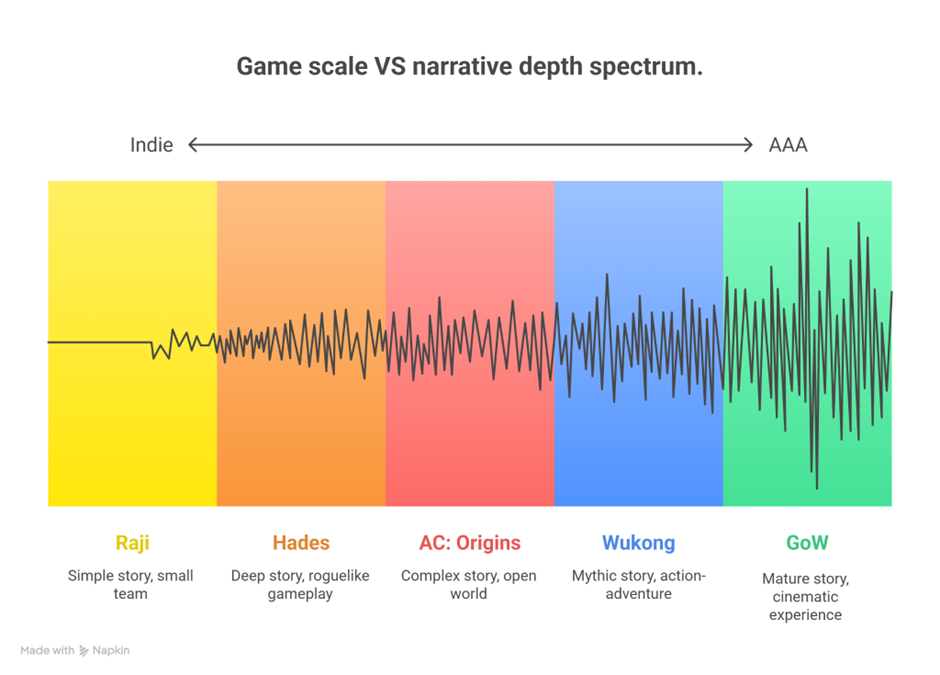
Hades showed how narrative can turn failure into progress, with every death unlocking new dialogue instead of a static “game over” screen. Raji: An Ancient Epic wove Indian miniature painting into its environments, making the art style itself a character. Assassin’s Creed: Origins used ancient Egypt not just as a backdrop but as a living world players could explore and learn from. The lesson is clear: narrative cannot be bolted on; it must live inside the gameplay loop.
Case Studies: When Stories Became Strategy
God of War (2018): Reinvention Playbook
Pivoted from Greek spectacle to Norse intimacy. Sold 5M in first month, 23M by 2022. Critical acclaim hinged on the emotional father-son arc. Proved cultural pivot = commercial rebirth.
Hades: Narrative Loop Innovation
7M+ copies sold. Each death unlocks dialogue. Story became the “grind,” solving roguelike churn.
Black Myth: Wukong: Global Breakthrough
Based on Journey to the West, it sold 28M copies in 2 weeks, grossing $850M. Sparked a 160% tourism spike in China. Proof: non-Western narratives can dominate globally.
Raji: An Ancient Epic: Indie Authenticity
Indian/Balinese cultural inspiration, traditional art styles. Won 36 international awards, proved niche + authenticity = global recognition.
Assassin’s Creed: Origins: Hybrid Commercial Model
Shifted series to ancient Egypt, combining open-world systems with cultural lore. Sold 10M copies, drove years of DLC, and fed into Assassin’s Creed Valhalla’s Norse expansion.
Consumer POV: What Players Actually Say
The commercial logic only works because players care. Community conversations on Reddit and Discord reveal recurring themes:
Gamers want authenticity, not exoticism. They notice when culture is treated as a costume.
Nostalgia sells. Many are drawn to stories that remind them of their own childhood or heritage.
Narrative-rich games inspire fan labour - mods, fan art, lore wikis, which extend the IP’s life without extra marketing spend.
This alignment of consumer demand with publisher economics is rare. Right now, it’s one of the strongest bets in gaming.
The Risks and How to Manage Them
None of this is risk-free. A poorly executed remake or cultural adaptation can tank reputations quickly, as Rockstar learned with the GTA Trilogy: Definitive Edition. Narrative branching is expensive to produce and test, which can lead to budget overruns. And there is always the opportunity cost: remakes or culturally inspired titles may crowd out original IP.
The best safeguard is vigilance; diverse teams, embedded consultants, and early community playtests.
Future Mapping: Where Narrative is Headed
AI-Augmented Storytelling: Procedural narrative design could allow branching at scale, while still guided by human cultural experts.
Transmedia Expansion: The Witcher and Arcane show IP can live across mediums. Investors will prioritise titles with transmedia hooks.
Shorter Nostalgia Cycles: Games from the 2010s (Skyrim, The Last of Us) are already being remade. Expect “nostalgia” to apply to Fortnite within a decade.
Closing
Cultural narratives are not gimmicks. They’re strategic assets that can carry franchises for decades. For founders, they’re a chance to stand out in a crowded market. For investors, they’re signals of durable IP with long-tail monetisation.
The future of gaming will not be built on mechanics alone. It will be built on stories. Stories that belong to all of us, retold through interactive worlds, and owned by players who see themselves in them.
This is part of how we think about interactive entertainment. Read our thesis, see the companies we back, or tell us what you're building.